
AIRT Uses UAS To Perform Damage Assessment In The Bahamas | Aero-News Network
Aero-News Network
RSS icon RSS feed
podcast icon MP3 podcast
Subscribe Aero-News e-mail Newsletter Subscribe

Airborne Unlimited -- Most Recent Daily Episodes

Episode Date

Airborne-Monday

Airborne-Tuesday

Airborne-Wednesday Airborne-Thursday

Airborne-Friday

Airborne On YouTube

Airborne-Unlimited-12.08.25

AirborneNextGen-
12.09.25

Airborne-Unlimited-12.10.25

Airborne-AffordableFlyers-12.11.25

AirborneUnlimited-12.12.25

AFE 2025 LIVE MOSAIC Town Hall (Archived): www.airborne-live.net

Fri, Sep 13, 2019

AIRT Uses UAS To Perform Damage Assessment In The Bahamas

Conducted Damage Assessment Operations At The University Of The Bahamas – Northern Campus

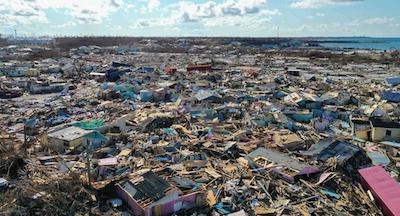
Members of the Airborne International Response Team (AIRT) formed a joint-reconnaissance team with members of the Southeast Florida Region 7 All-Hazards Incident Management Team (SEFL-R7 AHIMT) to survey damage across the hardest hit areas of Grand Bahama and the Abaco Islands in the Northern Bahamas following Hurricane Dorian.

Using UAS, the team conducted damage assessment operations at the University of the Bahamas – Northern Campus, and nearby neighborhoods that were hit hard by the deadly hurricane.

“We saw first-hand the damage that this hurricane leveled upon the Bahamas,” said Nigel Baker, team coordinator and incident commander of SEFL-R7 AHIMT. “The combination of massive storm surge and fierce Category 5 winds was more than most structures could bare, no matter what code they were built under.”

Equipped with high-resolution camera systems, the UAS are helping map disaster scenes in “new ways never before imaginable,” the team says. “By combining the drone with the latest rapid mapping technology, we were able to produce a highly accurate and incredibly detailed digital map of the hardest hit areas of Marsh Harbor and the other towns,” says Christopher Todd, executive director, AIRT.

For Todd, operations utilizing UAS following disasters like Dorian will soon become commonplace across the globe. “Beyond just search and rescue and damage assessment missions, these types of systems will help us provide a better understanding of what exactly happened, why it happened, and how it might be prevented from happening again in the future,” Todd said.

Baker adds, “this new technology is quickly providing new capabilities for emergency managers. More detailed information coming in quicker than ever before will allow us to make better decisions that will ultimately help save more lives.”

(Image provided with AUVSI news release)

FMI: www.airt.ngo
www.auvsi.org

Advertisement

More News

ANN's Daily Aero-Linx (12.12.25)

Aero Linx: Commercial Aviation Safety Team (CAST) Founded in 1997, the Commercial Aviation Safety Team (USCAST) has developed an integrated, data-driven strategy to reduce the comm>[...]

ANN's Daily Aero-Term (12.12.25): Land And Hold Short Operations

Land And Hold Short Operations Operations that include simultaneous takeoffs and landings and/or simultaneous landings when a landing aircraft is able and is instructed by the cont>[...]

ANN FAQ: How Do I Become A News Spy?

We're Everywhere... Thanks To You! Even with the vast resources and incredibly far-reaching scope of the Aero-News Network, every now and then a story that should be reported on sl>[...]

NTSB Final Report: Cirrus Design Corp SF50

Pilot’s Inadvertent Use Of The Landing Gear Control Handle Instead Of The Flaps Selector Switch During The Landing Rollout Analysis: The pilot reported that during the landin>[...]

Airborne 12.08.25: Samaritan’s Purse Hijack, FAA Med Relief, China Rocket Fail

Also: Cosmonaut Kicked Out, Airbus Scales Back, AF Silver Star, Russian A-60 Clobbered A Samaritan’s Purse humanitarian flight was hijacked on Tuesday, December 2, while atte>[...]

blog comments powered by Disqus



Advertisement

Advertisement

Podcasts

Advertisement

© 2007 - 2025 Web Development & Design by Pauli Systems, LC

