A Flawless And Record-Setting Mission For The 'S.S. John Glenn'
The “S.S. John Glenn” Cygnus spacecraft has successfully completed its seventh cargo logistics mission to the International Space Station under NASA’s Commercial Resupply Services (CRS-1) contract. The mission also marked the third time that Cygnus was used as a research platform for conducting in-space research with all mission objectives executed as planned.
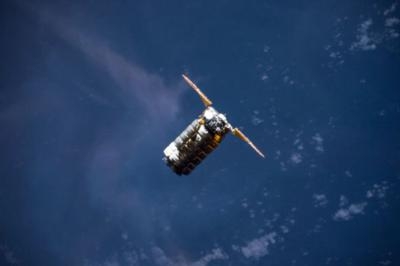
“Our departure from the International Space Station six weeks ahead of schedule once again proves Orbital ATK’s versatility, flexibility and dedication to our NASA customer,” said Frank Culbertson, President of Orbital ATK’s Space Systems Group. “The flawless completion of our fourth cargo delivery trip in a little more than a year demonstrates our commitment to deliver mission success and represents a fitting tribute to the life and accomplishments of one of the great American heroes of our time, John Glenn. We are proud to have flown the S.S. John Glenn in his honor.”
The OA-7 mission officially concluded on June 11 at approximately 1:08 p.m. EDT when Cygnus performed a safe, destructive reentry into the Earth’s atmosphere over the Pacific Ocean east of New Zealand.
Cygnus was launched on April 18 from Cape Canaveral Air Force Station in Florida. Four days later, the spacecraft arrived at the International Space Station and delivered approximately 7,600 pounds (3,450 kilograms) of cargo to the astronauts. The cargo included a NanoRacks CubeSat deployer, food, clothing, crew supplies, spare parts, packaging materials and laboratory equipment.
The spacecraft remained docked for 44 days and departed the space station on June 4 carrying approximately 4,300 pounds of items for disposal, a new record for Cygnus.
Upon departing the space station and clearing its orbit, the S.S. John Glenn successfully completed phase two of the OA-7 mission – serving as a platform to advance research in space, independent of the orbiting laboratory. It conducted the Spacecraft Fire Experiment-III (Saffire-III), deployed four CubeSats into orbit and initiated an experiment to analyze what happens to a spacecraft during reentry into Earth’s atmosphere.
Designed by NASA’s Glenn Research Center and funded by NASA’s Advanced Exploration Systems Division, Saffire-III was the third in a series of tests that studied how large-scale fires behave in microgravity. Cygnus has hosted the entire series of Saffire experiments to date.
The four CubeSats were released into orbit using a NanoRacks deployer. The spacecraft boosted its altitude to 481 kilometers before releasing the satellites into orbit. This action increases the on-orbit lifespan of the satellites to approximately seven years, compared to only three years had they been deployed from the International Space Station. Now in their intended positions, the satellites will assist in global ship tracking.
The final experiment utilized three Reentry Data Collection Flight Recorders to obtain data showcasing the extreme conditions a spacecraft encounters when reentering Earth’s atmosphere. It also tested the performance of different heat shield materials that may be used on future U.S. space missions.
Pending NASA’s specific cargo needs, Orbital ATK is prepared to launch two additional CRS missions this year aboard the company’s Antares rockets from NASA’s Wallops Flight Facility in Virginia.
(Source: Orbital ATK news release. Image from file)



 ANN's Daily Aero-Linx (12.12.25)


 See All