Fri, Feb 11, 2005
Northrop-Grumman Hunter II Features Heavy Fuel Engine As Part
Of Baseline Design
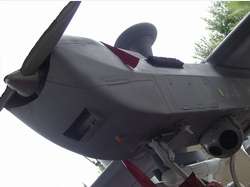 Northrop Grumman has started ground
and flight demonstrations of the new Hunter II medium altitude
endurance unmanned aerial vehicle (UAV) it has proposed as the US
Army's next generation UAV system.
Northrop Grumman has started ground
and flight demonstrations of the new Hunter II medium altitude
endurance unmanned aerial vehicle (UAV) it has proposed as the US
Army's next generation UAV system.
The flights are being conducted at Libby Army Air Field here as
part of a six-week-long flight demonstration between two competing
air-vehicle designs selected for the Phase I System Concept
Demonstration (SCD) phase of the Army's Extended
Range/Multi-Purpose UAV program. The SCD program is designed
to demonstrate the maturity of the proposed UAV designs.
"Northrop Grumman's Hunter II air vehicle will be 100 percent
compliant with the ER/MP program's threshold requirements, and will
demonstrate a heavy fuel engine configuration in advance of the
Army's requirements," said Bill McCall, Northrop Grumman's ER/MP
program director. "Our new Hunter II UAV system is designed
to be operated and maintained easily by enlisted soldiers and
non-commissioned officers, who already are familiar with the Hunter
UAV. Its new avionics and communications capabilities will
also provide Army land commanders with the situational awareness
they need to 'see and exploit' the land battlefield in a timely
manner."
Northrop Grumman's SCD activities include a variety of
ground and test flights to evaluate the Hunter II demonstrator air
vehicle's flight characteristics including speed, endurance, range
and altitude. For the test program, the company is using three
Hunter II demonstrator air vehicles, one of which is configured
with a heavy fuel engine.
The SCD competition is expected to culminate in a Phase II
system development and demonstration contract awarded to a single
contractor in the second quarter of 2005.
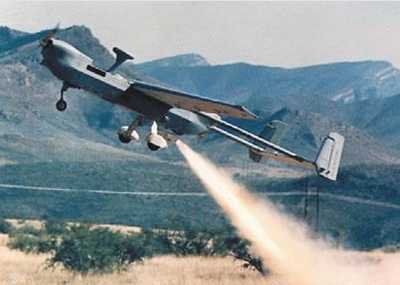
Hunter II is a twin-boom, autonomous UAV that builds on
the legacy of the battle-proven family of Hunter UAVs. It
features a sensor suite that includes electro-optical/infrared and
synthetic aperture radar systems; software architecture that can
easily accommodate new payloads and data-handling requirements;
state-of-the-art avionics; a weapons capability and a
communications subsystem that allows it to share data seamlessly
with current battlefield networks; and a fully automatic take-off
and landing system.
More News
Aero Linx: Commercial Aviation Safety Team (CAST) Founded in 1997, the Commercial Aviation Safety Team (USCAST) has developed an integrated, data-driven strategy to reduce the comm>[...]
Land And Hold Short Operations Operations that include simultaneous takeoffs and landings and/or simultaneous landings when a landing aircraft is able and is instructed by the cont>[...]
We're Everywhere... Thanks To You! Even with the vast resources and incredibly far-reaching scope of the Aero-News Network, every now and then a story that should be reported on sl>[...]
Pilot’s Inadvertent Use Of The Landing Gear Control Handle Instead Of The Flaps Selector Switch During The Landing Rollout Analysis: The pilot reported that during the landin>[...]
Also: Cosmonaut Kicked Out, Airbus Scales Back, AF Silver Star, Russian A-60 Clobbered A Samaritan’s Purse humanitarian flight was hijacked on Tuesday, December 2, while atte>[...]



 ANN's Daily Aero-Linx (12.12.25)


 See All