
NASA Celebrates Successful GLAST Blast(off) | Aero-News Network
Aero-News Network
RSS icon RSS feed
podcast icon MP3 podcast
Subscribe Aero-News e-mail Newsletter Subscribe

Airborne Unlimited -- Most Recent Daily Episodes

Episode Date

Airborne-Monday

Airborne-Tuesday

Airborne-Wednesday Airborne-Thursday

Airborne-Friday

Airborne On YouTube

Airborne-Unlimited-12.08.25

AirborneNextGen-
12.09.25

Airborne-Unlimited-12.10.25

Airborne-AffordableFlyers-12.11.25

AirborneUnlimited-12.12.25

AFE 2025 LIVE MOSAIC Town Hall (Archived): www.airborne-live.net

Thu, Jun 12, 2008

NASA Celebrates Successful GLAST Blast(off)

Observatory On-Orbit, Functioning Normally

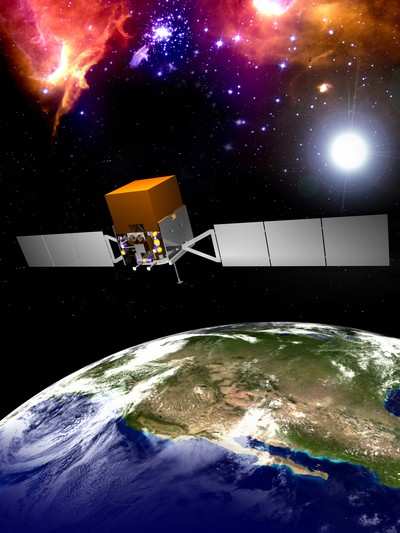
NASA's Gamma-ray Large Area Space Telescope, or GLAST, successfully launched aboard a Delta II rocket from Cape Canaveral Air Force Station in Florida at 1205 EDT Wednesday.

The GLAST observatory separated from the second stage of the Delta II at 1320 EDT and the flight computer immediately began powering up the components necessary to control the satellite. Twelve minutes after separating from the launch vehicle, both GLAST solar arrays were deployed. The arrays immediately began producing the power necessary to maintain the satellite and instruments. The operations team continues to check out the spacecraft subsystems.

"The entire GLAST Team is elated the observatory is now on-orbit and all systems continue to operate as planned," said GLAST program manager Kevin Grady of NASA's Goddard Space Flight Center in Greenbelt, MD.

After a 75-minute flight, the GLAST spacecraft was deployed into low Earth orbit. It will begin to transmit initial instrument data after about three weeks. The telescope will explore the most extreme environments in the universe, searching for signs of new laws of physics and investigating what composes mysterious dark matter. It will seek explanations for how black holes accelerate immense jets of material to nearly light speed, and look for clues to crack the mysteries behind powerful explosions known as gamma-ray bursts.

"After a 60-day checkout and initial calibration period, we'll begin science operations," said Steve Ritz, GLAST project scientist at Goddard. "GLAST soon will be telling scientists about many new objects to study, and this information will be available on the internet for the world to see."

"The Delta II gave us a good flight. It put GLAST in an orbit that's right on target," said NASA launch director Omar Baez.

NASA's GLAST mission is an astrophysics and particle physics partnership, developed in collaboration with the US Department of Energy, along with important contributions from academic institutions and partners in France, Germany, Italy, Japan, Sweden, and the US.

FMI: www.nasa.gov/glast 

Advertisement

More News

ANN's Daily Aero-Linx (12.12.25)

Aero Linx: Commercial Aviation Safety Team (CAST) Founded in 1997, the Commercial Aviation Safety Team (USCAST) has developed an integrated, data-driven strategy to reduce the comm>[...]

ANN's Daily Aero-Term (12.12.25): Land And Hold Short Operations

Land And Hold Short Operations Operations that include simultaneous takeoffs and landings and/or simultaneous landings when a landing aircraft is able and is instructed by the cont>[...]

ANN FAQ: How Do I Become A News Spy?

We're Everywhere... Thanks To You! Even with the vast resources and incredibly far-reaching scope of the Aero-News Network, every now and then a story that should be reported on sl>[...]

NTSB Final Report: Cirrus Design Corp SF50

Pilot’s Inadvertent Use Of The Landing Gear Control Handle Instead Of The Flaps Selector Switch During The Landing Rollout Analysis: The pilot reported that during the landin>[...]

Airborne 12.08.25: Samaritan’s Purse Hijack, FAA Med Relief, China Rocket Fail

Also: Cosmonaut Kicked Out, Airbus Scales Back, AF Silver Star, Russian A-60 Clobbered A Samaritan’s Purse humanitarian flight was hijacked on Tuesday, December 2, while atte>[...]

blog comments powered by Disqus



Advertisement

Advertisement

Podcasts

Advertisement

© 2007 - 2025 Web Development & Design by Pauli Systems, LC

