
NASA's 747SP Heads into Retirement | Aero-News Network
Aero-News Network
RSS icon RSS feed
podcast icon MP3 podcast
Subscribe Aero-News e-mail Newsletter Subscribe

Airborne Unlimited -- Most Recent Daily Episodes

Episode Date

Airborne-Monday

Airborne-Tuesday

Airborne-Wednesday Airborne-Thursday

Airborne-Friday

Airborne On YouTube

Airborne-Unlimited-12.01.25

AirborneNextGen-
12.02.25

Airborne-Unlimited-12.03.25

Airborne-FltTraining-12.04.25

AirborneUnlimited-12.05.25

AFE 2025 LIVE MOSAIC Town Hall (Archived): www.airborne-live.net

Sun, Jan 08, 2023

NASA's 747SP Heads into Retirement

New Home at Pima Air Museum Will Provide Home for Atmospheric Research Craft

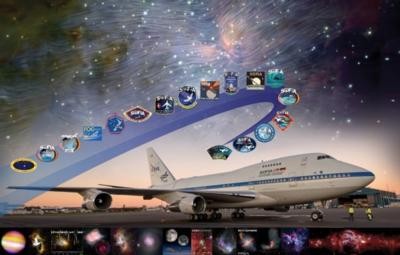
SOFIA, NASA's faithful 747SP, is all set for delivery to its new home at the Pima Air & Space Museum in Tucson, Arizona.

The plane took off for the last time from NASA’s Armstrong Flight Research Center in Palmdale, California, seen off by the local community of maintainers and program personnel before heading out to remain on display. Throughout her time as the SOFIA program's mobile laboratory, the aircraft granted the astrophysical community "unprecedented access to the mid- and far-infrared wavelengths of light," thanks to her considerable data gathering capability far above the 'dirty' magnetic fields of the earth below. From her operating altitude, SOFIA was able to fly above nearly 100% of the water aloft in the atmosphere, allowing those aboard and down below to study cosmic magnetic fields in astrophysics. While similar observatories existed, none were so mobile or feature-rich in such a small (at least smaller than a land-based observatory) package. 

The aircraft was the result of a joint NASA and German Space Agency effort at DLR. DLR provided the telescope, scheduled aircraft maintenance, and other support for the mission. NASA’s Ames Research Center in California’s Silicon Valley managed the SOFIA program, science, and mission operations in cooperation with the Universities Space Research Association, headquartered in Columbia, Maryland, and the German SOFIA Institute at the University of Stuttgart.

“We want to express our gratitude to everyone, both our U.S. and German colleagues, who, over the years, developed, tested, and operated the observatory at Ames and Armstrong. It has been an incredible team effort to create and operate the world’s largest airborne observatory. None of this would have been possible without the community of scientists who have used and supported SOFIA over the years. We look forward to hearing everything the SOFIA scientific community learns as we go on. It is with heartfelt thanks that we at NASA say goodbye to SOFIA. We are sad to see you go but so happy to have worked with the SOFIA team.”

FMI: www.nasa.gov

Advertisement

More News

Aero-FAQ: Dave Juwel's Aviation Marketing Stories -- ITBOA BNITBOB

Dave Juwel's Aviation Marketing Stories ITBOA BNITBOB ... what does that mean? It's not gibberish, it's a lengthy acronym for "In The Business Of Aviation ... But Not In The Busine>[...]

NTSB Prelim: Rutan Long-EZ

The Pilot Attempted Several Times To Restart The Engine And Diverted To Long Beach Airport/Daughtery Field On October 20, 2025, about 1603 Pacific daylight time, an experimental am>[...]

ANN's Daily Aero-Term (12.05.25): Hazardous Weather Information

Hazardous Weather Information Summary of significant meteorological information (SIGMET/WS), convective significant meteorological information (convective SIGMET/WST), urgent pilot>[...]

Aero-News: Quote of the Day (12.05.25)

"The latest development underscores the government of Malaysia’s commitment in providing closure to the families affected by this tragedy..." Source: From statements made by >[...]

Airborne-Flight Training 12.04.25: Ldg Fee Danger, Av Mental Health, PC-7 MKX

Also: IAE Acquires Diamond Trainers, Army Drones, FedEx Pilots Warning, DA62 MPP To Dresden Tech Uni The danger to the flight training industry and our future pilots is clear. Dona>[...]

blog comments powered by Disqus



Advertisement

Advertisement

Podcasts

Advertisement

© 2007 - 2025 Web Development & Design by Pauli Systems, LC

