

Advanced Military Satellite Safely Reaches Orbit | Aero-News Network
Aero-News Network
RSS icon RSS feed
podcast icon MP3 podcast
Subscribe Aero-News e-mail Newsletter Subscribe

Airborne Unlimited -- Most Recent Daily Episodes

Episode Date

Airborne-Monday

Airborne-Tuesday

Airborne-Wednesday Airborne-Thursday

Airborne-Friday

Airborne On YouTube

Airborne-Unlimited-12.01.25

AirborneNextGen-
12.02.25

Airborne-Unlimited-12.03.25

Airborne-FltTraining-12.04.25

AirborneUnlimited-12.05.25

AFE 2025 LIVE MOSAIC Town Hall (Archived): www.airborne-live.net

Mon, Dec 07, 2009

Advanced Military Satellite Safely Reaches Orbit

Delta IV Launch Delivers Third Piece Of New Communications System

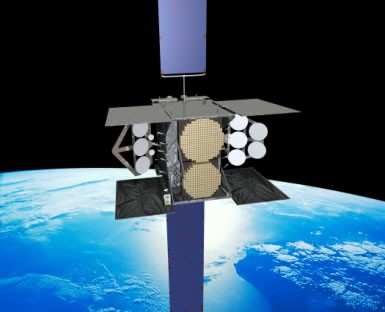
A new configuration of the Delta IV rocket left its Florida launch pad on Saturday around 8:47 pm carrying a next-generation Air Force satellite.   Lift-off occurred at the very end of a 90-minute launch window and after several days of delay caused by unfavorable weather around Cape Canaveral.

The success is good news for United Launch Alliance (ULA), a 2006 joint venture of Lockheed Martin and Boeing.  ULA had never flown this specific configuration of the rocket with the larger 5-meter payload shroud and a total of 4 strap-on boosters.

ULA provides both the Atlas and Delta families of expendable rockets for the DOD and NASA.  The high success rate for ULA vehicles has been quoted in recent talk of revisions to NASA's moon plans. Improved versions of Delta and Atlas vehicles have been proposed as replacements for the Ares I rocket being developed internally by NASA.

The rocket's payload was the third Wideband Global SATCOM (WGS-3) spacecraft, a $300 million, 6.5 ton satellite.  There are a total of six satellites being developed by defense departments in the US and Australia as a part of a new high-capacity communications system.

WGS replaces the current Defense Satellite Communication System (DSCS) that has been in operation for more than two decades.  The older system cannot process the high data rates common in today's technology.  Troops in Afghanistan and Iraq are already benefitting from vast improvements in communications provided by the two WGS spacecraft already in orbit, including downloads of up to 2.4 Gigabits/second.

Air Force Maj. Mark Hadley, a deputy program manager for WGS explained the impact of the new system on military capabilities. "It provides voice, data and commanding at about 10 times the data rate that was previously available," said Hadley. "It really is a game-changer."

FMI www.ULAlaunch.com and www.afspc.af.mil

Advertisement

More News

ANN's Daily Aero-Term (12.04.25): Cooperative Surveillance

Cooperative Surveillance Any surveillance system, such as secondary surveillance radar (SSR), wide-area multilateration (WAM), or ADS-B, that is dependent upon the presence of cert>[...]

ANN's Daily Aero-Linx (12.04.25)

Aero Linx: OX5 Aviation Pioneers Incorporated in 1955 as a Pa 501 (c)(3) Not for Profit Corporation, the OX5 Aviation Pioneers is dedicated to bringing before the public the accomp>[...]

NTSB Prelim: Extra Flugzeugproduktions EA 300/SC

The Pilot Appeared To Regain Control After Six Rotations And Attempted To “Fly Out” Inverted But Had Insufficient Altitude On November 8, 2025, at 1038 eastern standard>[...]

Classic Aero-TV: The Bally Bomber - The All Time Ultimate Warbird Replica?

From 2018 (YouTube Edition): Aero-News Talks With The Airplane's Builder One of the many unique airplanes at AirVenture 2018 was a 1/3-scale B-17 bomber built by Jack Bally, who ta>[...]

ANN's Daily Aero-Linx (12.05.25)

Aero Linx: Society of U.S. Army Flight Surgeons (SoUSAFS) The Society of US Army Flight Surgeons (SoUSAFS) serves to advance the science and art of Aerospace Medicine and its allie>[...]

blog comments powered by Disqus



Advertisement

Advertisement

Podcasts

Advertisement

© 2007 - 2025 Web Development & Design by Pauli Systems, LC

