
NASA Sourcing Volunteer Data Surrounding April 8 Eclipse | Aero-News Network
Aero-News Network
RSS icon RSS feed
podcast icon MP3 podcast
Subscribe Aero-News e-mail Newsletter Subscribe

Airborne Unlimited -- Most Recent Daily Episodes

Episode Date

Airborne-Monday

Airborne-Tuesday

Airborne-Wednesday Airborne-Thursday

Airborne-Friday

Airborne On YouTube

Airborne-Unlimited-12.01.25

AirborneNextGen-
12.02.25

Airborne-Unlimited-11.19.25

Airborne-AffordableFlyers-11.20.25

AirborneUnlimited-11.21.25

LIVE MOSAIC Town Hall (Archived): www.airborne-live.net

Thu, Apr 04, 2024

NASA Sourcing Volunteer Data Surrounding April 8 Eclipse

Students, Educators, & Enthusiasts Help Out With Data Gathering

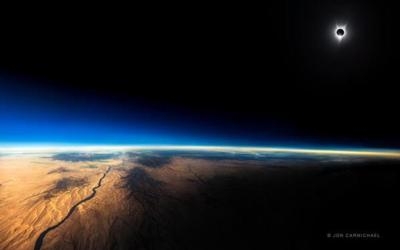
The upcoming total solar eclipse is once again proving to be a useful little STEM activity for kids & students, and NASA has dusted off their GLOBE app to crowdsource some more info from onlookers across the country.

Participants are asked to measure their local air temperatures and snap pictures of clouds, says NASA. In years past, similar activities were sort of a fun, STEM-centered way to involve kids in the global scientific community. But for the 2024 go-around, NASA needs the data more than ever, since there's less weather station coverage throughout the path of the eclipse.

The efforts are a part of the GLOBE program, short for Global Learning and Observations to Benefit the Environment. Using the associated phone application, volunteers can undertake a variety of measuring tasks across a wide breadth of environmental studies. For the upcoming eclipse, however, NASA is eager to soak up as much information as they can glean, citing a lack of comprehensive, large scale data collection in eclipses past.

In the last North American eclipse in 2017, NASA was able to further determine the insulation effect of cloud cover by comparing the temperatures below the eclipse path. They ultimately found wider temp swings in uncovered, cloudless areas than they did heavily covered regions. Now, that's not much of a surprise, but data is data, and sometimes the intuitive expectation has to be put in absolute, provable terms to stand on its own merits around the NASA water cooler.

"The number of weather stations along this year’s eclipse path is limited, and while satellites give us a global view, they can’t provide the same level of detail as people on the ground," said Ashlee Autore, a NASA Langley data scientist who will be conducting a follow-up to the 2017 study. “The power of citizen science is that people make the observations, and they can move.”

FMI: www.globe.gov

Advertisement

More News

ANN's Daily Aero-Term (12.01.25): Convective SIGMET

Convective SIGMET A weather advisory concerning convective weather significant to the safety of all aircraft. Convective SIGMETs are issued for tornadoes, lines of thunderstorms, e>[...]

ANN's Daily Aero-Linx (12.01.25)

Aero Linx: United Flying Octogenarians WELCOME to a most extraordinary group of aviators, the United Flying Octogenarians (UFO). Founded in 1982 with just a handful of pilots, we h>[...]

NTSB Final Report: Remos Aircraft GmbH Remos GX

Pilot’s Decision To Attempt Takeoff With Frost Covering The Airplane’s Wings Analysis: The pilot of the light sport airplane was preparing to depart for a cross-country>[...]

Aero-News: Quote of the Day (12.02.25)

“We’ve paid for the cable line’s repair for the customer and have apologized for the inconvenience this caused them...” Source: Some followup info from an A>[...]

ANN's Daily Aero-Term (12.02.25): Coupled Approach

Coupled Approach An instrument approach performed by the aircraft autopilot, and/or visually depicted on the flight director, which is receiving position information and/or steerin>[...]

blog comments powered by Disqus



Advertisement

Advertisement

Podcasts

Advertisement

© 2007 - 2025 Web Development & Design by Pauli Systems, LC

