
Jet Fuel Contamination Subject Of NTSB Safety Alert | Aero-News Network
Aero-News Network
RSS icon RSS feed
podcast icon MP3 podcast
Subscribe Aero-News e-mail Newsletter Subscribe

Airborne Unlimited -- Most Recent Daily Episodes

Episode Date

Airborne-Monday

Airborne-Tuesday

Airborne-Wednesday Airborne-Thursday

Airborne-Friday

Airborne On YouTube

Airborne-Unlimited-11.24.25

AirborneNextGen-
11.18.25

Airborne-Unlimited-11.19.25

Airborne-AffordableFlyers-11.20.25

AirborneUnlimited-11.21.25

LIVE MOSAIC Town Hall (Archived): www.airborne-live.net

Tue, Jul 30, 2019

Jet Fuel Contamination Subject Of NTSB Safety Alert

Focus Is On Diesel Exhaust Fluid That Can Accumulate On Engine Components

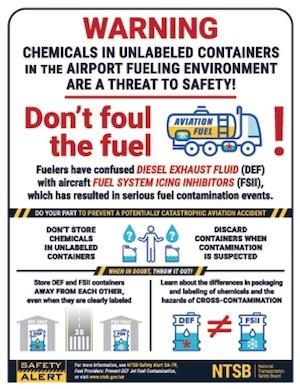
The NTSB has issued a Safety Alert SA-079 warning providers of jet fuel to take measures to prevent contamination of jet fuel by diesel exhaust fluid.

Diesel exhaust fluid (DEF) is required for all new on- and off-road, diesel-powered vehicles, making the presence of the clear, colorless liquid more prevalent at airfields as refueling trucks are replaced. When introduced into a diesel-powered vehicle’s exhaust stream, DEF is beneficial in the reduction of nitrogen oxide emissions.  However, when DEF is introduced into jet fuel, a chemical reaction occurs forming crystalline deposits that can accumulate on filters, engine fuel nozzles and fuel metering components, resulting in a loss of engine power.

When improperly stored in unmarked containers, DEF is a clear, colorless liquid that can be mistaken for other liquids found on the airfield, including fuel system icing inhibitors (FSII). Both DEF and FSII can be purchased in bulk and transferred to smaller containers for ease of use. Under these circumstances, unlabeled containers and common storage areas increase the likelihood of confusing these liquids.

The NTSB wants fuel providers to ensure they store all chemicals in labeled containers and that they add a “NOT FOR AVIATION USE” label to all DEF containers.

Aviation fuel contamination of all types is a longstanding safety issue and inadvertent introduction of DEF into aviation fuel is the latest iteration of the issue. The NTSB is currently investigating a May 2019 incident in which a Cessna C550 experienced a total loss of engine power to both engines during an air medical flight. The crew diverted the plane to a nearby airport and safely landed. Analysis of fuel samples, fuel system filters and fuel screens from the airplane indicated the presence of urea, the primary chemical found in DEF. During the investigation, an airport lineman reported the day before the incident he combined two partially filled containers.

Further investigation revealed that one container held FSII and the other held DEF, which he mistook for FSII. He subsequently added the combined fluid to the fuel truck’s FSII reservoir and fueled the Cessna the next day with 480 gallons of the Jet A fuel containing the FSII and DEF mixture. Two other instances of the inadvertent introduction of DEF into aircraft fuel tanks, after being combined with FSII, have been documented. Because both instances were identified before the aircraft attempted flight, neither event was investigated by the NTSB.

(Infographic provided with NTSB news release)

FMI: www.ntsb.gov

Advertisement

More News

Classic Aero-TV: Extra; the Airplane, the Man, and His Grand DeLand Plan

From 2023 (YouTube Edition): Germany’s Best by Way of Florida Established in 1980 by German aerobatic pilot Walter Extra as a means by which to design and develop his own air>[...]

ANN FAQ: Follow Us On Instagram!

Get The Latest in Aviation News NOW on Instagram Are you on Instagram yet? It's been around for a few years, quietly picking up traction mostly thanks to everybody's new obsession >[...]

Aero-News: Quote of the Day (11.27.25)

“Achieving PMA for the S-1200 Series magnetos is another step in expanding our commitment to providing the aviation community with the most trusted and durable ‘firewal>[...]

ANN's Daily Aero-Term (11.27.25): Ultralight Vehicle

Ultralight Vehicle A single-occupant aeronautical vehicle operated for sport or recreational purposes which does not require FAA registration, an airworthiness certificate, or pilo>[...]

ANN's Daily Aero-Linx (11.27.25)

Aero Linx: The de Havilland Moth Club Ltd The de Havilland Moth Club evolved from a belief that an association of owners and operators of Moth aeroplanes should be formed to create>[...]

blog comments powered by Disqus



Advertisement

Advertisement

Podcasts

Advertisement

© 2007 - 2025 Web Development & Design by Pauli Systems, LC

