
NASA, ESA Celebrate 10 Years Since Titan Landing | Aero-News Network
Aero-News Network
RSS icon RSS feed
podcast icon MP3 podcast
Subscribe Aero-News e-mail Newsletter Subscribe

Airborne Unlimited -- Most Recent Daily Episodes

Episode Date

Airborne-Monday

Airborne-Tuesday

Airborne-Wednesday Airborne-Thursday

Airborne-Friday

Airborne On YouTube

Airborne-Unlimited-12.08.25

AirborneNextGen-
12.09.25

Airborne-Unlimited-12.10.25

Airborne-AffordableFlyers-12.11.25

AirborneUnlimited-12.12.25

AFE 2025 LIVE MOSAIC Town Hall (Archived): www.airborne-live.net

Fri, Jan 16, 2015

NASA, ESA Celebrate 10 Years Since Titan Landing

Probe Was Able To Transmit Data For Only An Hour Before Batteries Were Drained

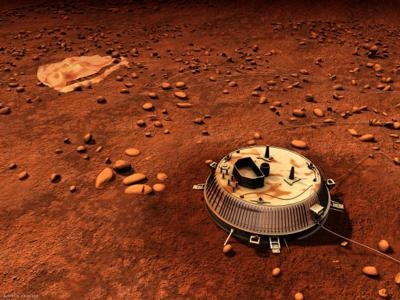
Ten years ago, an explorer from Earth parachuted into the haze of an alien moon toward an uncertain fate. After a gentle descent lasting more than two hours, it landed with a thud on a frigid floodplain, surrounded by icy cobblestones. With this feat, the Huygens probe accomplished humanity's first landing on a moon in the outer solar system. Huygens was safely on Titan, the largest moon of Saturn.

The hardy probe not only survived the descent and landing, but continued to transmit data for more than an hour on the frigid surface of Titan, until its batteries were drained.

Since that historic moment, scientists from around the world have pored over volumes of data about Titan, sent to Earth by Huygens -- a project of the European Space Agency -- and its mothership, NASA's Cassini spacecraft. In the past 10 years, data from the dynamic spacecraft duo have revealed many details of a surprisingly Earth-like world.
 
In addition to the technical wizardry needed to pull off this tour de force, international partnerships were critical to successfully delivering the two spacecraft to Saturn and Titan.

"A mission of this ambitious scale represents a triumph in international collaboration,” said Earl Maize, Cassini Project manager at NASA's Jet Propulsion Laboratory in Pasadena, California.
 
"From the mission's formal beginning in 1982, to Huygens' spectacular landing 23 years later, to the present day, Cassini-Huygens owes much of its success to the tremendous synergy and cooperation between more than a dozen countries. This teamwork is still a major strength of the project as the Cassini orbiter continues to explore the Saturn system," Maize said.
 
Cassini's mission is slated to continue through September 2017.

(Image provided by NASA)

FMI: www.nasa.gov

Advertisement

More News

ANN's Daily Aero-Term (12.13.25): Light Gun

Light Gun A handheld directional light signaling device which emits a brilliant narrow beam of white, green, or red light as selected by the tower controller. The color and type of>[...]

Aero-News: Quote of the Day (12.13.25)

“We have performed extensive ground testing by comparing warm up times, full power tethered pulls, and overall temperatures in 100 degree environments against other aircraft >[...]

NTSB Final Report: Gippsland GA-8

While Taxiing To Parking The Right Landing Gear Leg Collapsed, Resulting In Substantial Damage Analysis: The pilot made a normal approach with full flaps and landed on the runway. >[...]

Classic Aero-TV: Historically Unique -- Marlin Horst's Exquisite Fairchild 71

From 2014 (YouTube Edition): Exotic Rebuild Reveals Aerial Work Of Art During EAA AirVenture 2014, ANN's Michael Maya Charles took the time to get a history lesson about a great ai>[...]

Airborne 12.12.25: Global 8000, Korea Pilot Honors, AV-30 Update

Also: Project Talon, McFarlane Acquisition, Sky-Tec Service, JPL Earth Helo Tests Bombardier has earned a round of applause from the business aviation community, celebrating the fo>[...]

blog comments powered by Disqus



Advertisement

Advertisement

Podcasts

Advertisement

© 2007 - 2025 Web Development & Design by Pauli Systems, LC

