
Boeing Wins Contract To Design DARPA Airborne Satellite Launch System | Aero-News Network
Aero-News Network
RSS icon RSS feed
podcast icon MP3 podcast
Subscribe Aero-News e-mail Newsletter Subscribe

Airborne Unlimited -- Most Recent Daily Episodes

Episode Date

Airborne-Monday

Airborne-Tuesday

Airborne-Wednesday Airborne-Thursday

Airborne-Friday

Airborne On YouTube

Airborne-Unlimited-12.01.25

AirborneNextGen-
12.02.25

Airborne-Unlimited-11.19.25

Airborne-AffordableFlyers-11.20.25

AirborneUnlimited-11.21.25

LIVE MOSAIC Town Hall (Archived): www.airborne-live.net

Fri, Apr 04, 2014

Boeing Wins Contract To Design DARPA Airborne Satellite Launch System

Would Allow Small Satellites To Be Launched From An F-15E

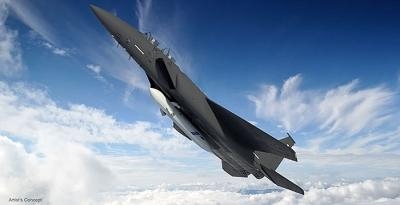
What Boeing vehicle would hitch a ride on an F-15E, drop from the aircraft, fire its engines and deploy microsatellites into space? It’s a new satellite launch vehicle concept designed by Phantom Works Advanced Space Exploration for the Defense Advanced Research Projects Agency (DARPA) called the Airborne Launch Assist Space Access or ALASA.

Under an 11-month, $30.6-million contract with options to build up to 12 of the 24-foot vehicles, Boeing and DARPA intend to test the ability to cut the cost of routinely launching microsatellites into orbit by 66 percent. According to DARPA, ALASA aims to develop and employ radical advances in launch systems, leading to more affordable and responsive space access compared to current military and U.S. commercial launch operations.

Rockets today are designed using a number of stages, each with its own engine and fuel tanks. The first stage is at the bottom and is usually the largest, the second and subsequent upper stages are above it, and normally decrease in size. “With our design, the first and second stages are powered by the same engines, reducing weight and complexity.”

As these stages are jettisoned (or dropped), the fuel tank and engines are just thrown away. We developed a cost-effective design by moving the engines forward on the launch vehicle. With our design, the first and second stages are powered by the same engines, reducing weight and complexity,” explained Steve Johnston, director, Advanced Space Exploration.

The 24-foot ALASA vehicle is designed to attach under an F-15E aircraft. Once the airplane reaches approximately 40,000 feet, it would release the ALASA vehicle. The vehicle would then fire its four main engines and launch into low-Earth orbit to deploy one or more microsatellites weighing up to a total of 100 pounds.

(Image provided by Boeing)

FMI: www.boeing.com

Advertisement

More News

ANN's Daily Aero-Term (12.01.25): Convective SIGMET

Convective SIGMET A weather advisory concerning convective weather significant to the safety of all aircraft. Convective SIGMETs are issued for tornadoes, lines of thunderstorms, e>[...]

ANN's Daily Aero-Linx (12.01.25)

Aero Linx: United Flying Octogenarians WELCOME to a most extraordinary group of aviators, the United Flying Octogenarians (UFO). Founded in 1982 with just a handful of pilots, we h>[...]

NTSB Final Report: Remos Aircraft GmbH Remos GX

Pilot’s Decision To Attempt Takeoff With Frost Covering The Airplane’s Wings Analysis: The pilot of the light sport airplane was preparing to depart for a cross-country>[...]

Aero-News: Quote of the Day (12.02.25)

“We’ve paid for the cable line’s repair for the customer and have apologized for the inconvenience this caused them...” Source: Some followup info from an A>[...]

ANN's Daily Aero-Term (12.02.25): Coupled Approach

Coupled Approach An instrument approach performed by the aircraft autopilot, and/or visually depicted on the flight director, which is receiving position information and/or steerin>[...]

blog comments powered by Disqus



Advertisement

Advertisement

Podcasts

Advertisement

© 2007 - 2025 Web Development & Design by Pauli Systems, LC

