

EAA To FAA: Remote ID Rules Proposal Is Overreach | Aero-News Network
Aero-News Network
RSS icon RSS feed
podcast icon MP3 podcast
Subscribe Aero-News e-mail Newsletter Subscribe

Airborne Unlimited -- Most Recent Daily Episodes

Episode Date

Airborne-Monday

Airborne-Tuesday

Airborne-Wednesday Airborne-Thursday

Airborne-Friday

Airborne On YouTube

Airborne-Unlimited-12.01.25

AirborneNextGen-
12.02.25

Airborne-Unlimited-12.03.25

Airborne-AffordableFlyers-11.20.25

AirborneUnlimited-11.21.25

LIVE MOSAIC Town Hall (Archived): www.airborne-live.net

Wed, Mar 04, 2020

EAA To FAA: Remote ID Rules Proposal Is Overreach

In Official Comments, Offers Alternatives For Smooth UAS Airspace Integration

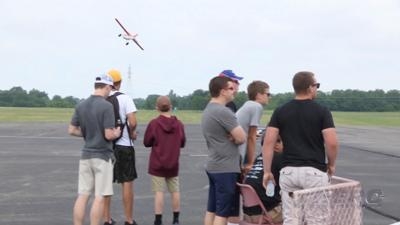
The FAA’s proposed rules for Unmanned Aerial System (UAS) integration is an overreaching answer and threatens traditional pathways into manned aviation, according to the Experimental Aircraft Association.

As part of its official comments submitted on March 2 to the FAA’s Notice of Proposed Rulemaking (NPRM) docket, EAA noted that in the agency’s attempt for regulations to keep pace with burgeoning UAS technology, it has harmed the freedoms and longstanding safe operations maintained by the traditional model aviation community. That community has little in common with the UAS operations that the FAA seeks to regulate, especially in such areas as non-line-of-sight operations and within controlled airspace.

“EAA fully understands the need to regulate UAS operations for public safety while safely integrating them into the national airspace,” said Sean Elliott, EAA’s vice president of advocacy and safety. “This FAA proposal, however, simply issues blanket regulations for all unmanned aerial operations, regardless of safety or compliance history. It threatens a long-successful pathway for people to engage in flight.”

EAA offered several alternatives that would fully regulate the new UAS operations that are requesting more expansive freedoms to fly in the national airspace, while acknowledging the outstanding safety and compliance record of traditional model aviation. Among those alternative solutions were:

  • Registration requirements for multiple traditional model aircraft owned by a specific operator can remain as a single registration, not separate registrations for each aircraft
  • Creation of a notification system not reliant on immediate, on-site internet connectivity
  • Establishment of FAA-recognized identification areas, such as model aircraft flying fields, directly with the FAA via a time-proven system such as FAA’s Web-based Operations Safety System

In January, EAA and other general aviation organizations had asked for a 30- to 60-day extension to the comment period, to allow all stakeholders to thoroughly review the 300-plus page NPRM and offer additional well-researched comments. The FAA rejected that request, stating that an extension as not in the public interest. Still, more than 44,000 comments were posted to the FAA docket, which is an extraordinary number considering most FAA NPRMs draw fewer than 1,000 comments.

“The unusually fast turnaround for this comment period has consequences that may include having to go back and fix bad decisions that were made in haste, while not using risk-based criteria,” Elliott said. “EAA is also concerned that rushed regulations set precedents that may eventually affect manned recreational aircraft operations, which is unacceptable.”

(Source: EAA news release. Images from file)

FMI: www.eaa.org

Advertisement

More News

ANN's Daily Aero-Term (12.01.25): Convective SIGMET

Convective SIGMET A weather advisory concerning convective weather significant to the safety of all aircraft. Convective SIGMETs are issued for tornadoes, lines of thunderstorms, e>[...]

ANN's Daily Aero-Linx (12.01.25)

Aero Linx: United Flying Octogenarians WELCOME to a most extraordinary group of aviators, the United Flying Octogenarians (UFO). Founded in 1982 with just a handful of pilots, we h>[...]

NTSB Final Report: Remos Aircraft GmbH Remos GX

Pilot’s Decision To Attempt Takeoff With Frost Covering The Airplane’s Wings Analysis: The pilot of the light sport airplane was preparing to depart for a cross-country>[...]

Aero-News: Quote of the Day (12.02.25)

“We’ve paid for the cable line’s repair for the customer and have apologized for the inconvenience this caused them...” Source: Some followup info from an A>[...]

ANN's Daily Aero-Term (12.02.25): Coupled Approach

Coupled Approach An instrument approach performed by the aircraft autopilot, and/or visually depicted on the flight director, which is receiving position information and/or steerin>[...]

blog comments powered by Disqus



Advertisement

Advertisement

Podcasts

Advertisement

© 2007 - 2025 Web Development & Design by Pauli Systems, LC

