
Airbus’ New Weight Variant A330neo Makes Its First Flight | Aero-News Network
Aero-News Network
RSS icon RSS feed
podcast icon MP3 podcast
Subscribe Aero-News e-mail Newsletter Subscribe

Airborne Unlimited -- Most Recent Daily Episodes

Episode Date

Airborne-Monday

Airborne-Tuesday

Airborne-Wednesday Airborne-Thursday

Airborne-Friday

Airborne On YouTube

Airborne-Unlimited-12.01.25

AirborneNextGen-
12.02.25

Airborne-Unlimited-12.03.25

Airborne-AffordableFlyers-11.20.25

AirborneUnlimited-11.21.25

LIVE MOSAIC Town Hall (Archived): www.airborne-live.net

Wed, Mar 04, 2020

Airbus’ New Weight Variant A330neo Makes Its First Flight

Certification Anticipated Later This Year

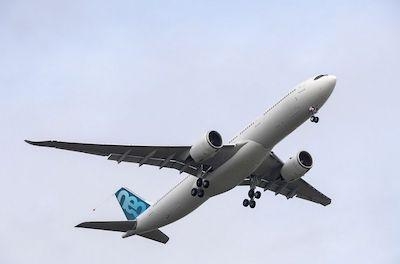
More range and even better economics: these are the key attributes of Airbus’ increased maximum take-off weight A330neo variant, which flew for the first time Friday.

Benefitting from a maximum take-off weight increase to 251 metric tons, the A330neo offers a significant 650-nautical mile boost in range – or six metric tons more payload – when compared to the A330neo’s current 242-metric ton version. This increase in range responds to evolving market needs, enabling airlines to benefit from the unique economics of the A330neo on even longer routes.

Taking to the skies for the first time this afternoon from Toulouse, France, was the 251-metric ton A330-900 – which provides the perfect fit for longer trans-Pacific or Asia-Europe routes. The A330-900 is the longer-fuselage A330neo version, seating 260-300 passengers in a typical three-class cabin configuration.

The shorter-fuselage A330-800 – which accommodates 220-260 passengers in a three-class configuration, will open up very-long-range Pacific routes for the 251-tonne version, while delivering the lowest seat-mile cost in its category.

The increased take-off weight A330-900 is expected to be certified by airworthiness authorities mid-2020, followed in 2021 by the A330-800 variant.

Airbus has retained 99% spares commonality for these A330neo versions, with their maximum take-off weight increases achieved through a combination of weight-neutral reinforcements and landing gear adaptations.

Modifications to the nose and main landing gear also enabled Airbus engineers to extend their time-before-overhaul (TBO), prolonging the previous 10-year interval to a new 12-year timeframe, thus resulting in significant maintenance savings.

(Image provided with Airbus news release)

FMI: www.airbus.com

Advertisement

More News

ANN's Daily Aero-Term (12.01.25): Convective SIGMET

Convective SIGMET A weather advisory concerning convective weather significant to the safety of all aircraft. Convective SIGMETs are issued for tornadoes, lines of thunderstorms, e>[...]

ANN's Daily Aero-Linx (12.01.25)

Aero Linx: United Flying Octogenarians WELCOME to a most extraordinary group of aviators, the United Flying Octogenarians (UFO). Founded in 1982 with just a handful of pilots, we h>[...]

NTSB Final Report: Remos Aircraft GmbH Remos GX

Pilot’s Decision To Attempt Takeoff With Frost Covering The Airplane’s Wings Analysis: The pilot of the light sport airplane was preparing to depart for a cross-country>[...]

Aero-News: Quote of the Day (12.02.25)

“We’ve paid for the cable line’s repair for the customer and have apologized for the inconvenience this caused them...” Source: Some followup info from an A>[...]

ANN's Daily Aero-Term (12.02.25): Coupled Approach

Coupled Approach An instrument approach performed by the aircraft autopilot, and/or visually depicted on the flight director, which is receiving position information and/or steerin>[...]

blog comments powered by Disqus



Advertisement

Advertisement

Podcasts

Advertisement

© 2007 - 2025 Web Development & Design by Pauli Systems, LC

