
University Of Maryland Achieves First Solar-Powered, Piloted Helicopter Flight | Aero-News Network
Aero-News Network
RSS icon RSS feed
podcast icon MP3 podcast
Subscribe Aero-News e-mail Newsletter Subscribe

Airborne Unlimited -- Most Recent Daily Episodes

Episode Date

Airborne-Monday

Airborne-Tuesday

Airborne-Wednesday Airborne-Thursday

Airborne-Friday

Airborne On YouTube

Airborne-Unlimited-12.08.25

AirborneNextGen-
12.09.25

Airborne-Unlimited-12.10.25

Airborne-AffordableFlyers-12.11.25

AirborneUnlimited-12.12.25

AFE 2025 LIVE MOSAIC Town Hall (Archived): www.airborne-live.net

Fri, Sep 16, 2016

University Of Maryland Achieves First Solar-Powered, Piloted Helicopter Flight

No More Pedaling ... Gamera Team Switches To Solar

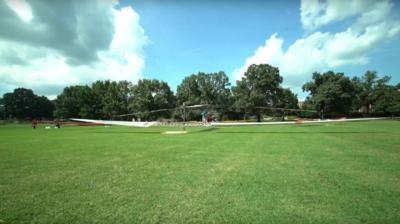
A University of Maryland student team has once again achieved new aviation heights, this time by successfully lifting a helicopter and passenger through the sole use of solar power.

After successfully completing the longest duration flight for a human-powered helicopter in fall of 2013, the UMD Gamera Team, a student team originally inspired in 2012 by the American Helicopter Society’s Sikorsky Prize, has continued raising the bar. In 2014, a new group of undergraduate students took over Team Gamera, reinventing itself as Solar Gamera to test the feasibility of applying solar power in achieving human helicopter flight.

"Today you are seeing the first successful flights of the Gamera Solar-Powered Helicopter," said Ph.D. student William Staruk, who assisted with the flight and was a member of Gamera's Human-Powered Helicopter Team. "You are seeing aviation history being made in the history of green aviation and rotary blade aviation."

With materials science major Michelle Mahon in the cockpit, Solar Gamera achieved two successful flights, flying for 9 seconds and gaining more than a foot of height.

"It's just a matter of drift before [Solar Gamera] gets longer flights," explained Staruk. "It's easier to trim than human-powered helicopter thanks to electronic controls."

While electronic controls offer an advantage over Gamera's human-powered predecessor, the challenge of lifting a 100-foot square rotorcraft solely through solar power has posed its own unique set of challenges.

“This is about inspiring and educating students, that’s our product here," explained Distinguished Professor and Gamera faculty advisor Inderjit Chopra. “No one thought that solar energy could lift a person [via helicopter]."

The craft may never engage in long-distance flight, but through this project's immense hands-on opportunities, students hone their engineering chops and find focus for their future.

"When I started this, I had no idea what I wanted to do with my engineering degree," said Anthony Prete (B.S. '16), who served as Gamera S' team lead during the 2015-2016 school year. "This experience focused me into something, design."

More than a hundred students from across the Clark School have worked on Gamera at some point in the more than six years the team has been active, offering unlimited possibilities to explore achieving the impossible in engineering and flight.

"This project has come a long way in the past six or seven years from human-power to solar-power," added Staruk. "So we are breaking barriers of all sorts in aviation with this one airframe and we are very proud of that work here at the University of Maryland."

(Image provided with UMD news release)

FMI: www.umd.edu

Advertisement

More News

ANN's Daily Aero-Term (12.13.25): Light Gun

Light Gun A handheld directional light signaling device which emits a brilliant narrow beam of white, green, or red light as selected by the tower controller. The color and type of>[...]

Aero-News: Quote of the Day (12.13.25)

“We have performed extensive ground testing by comparing warm up times, full power tethered pulls, and overall temperatures in 100 degree environments against other aircraft >[...]

NTSB Final Report: Gippsland GA-8

While Taxiing To Parking The Right Landing Gear Leg Collapsed, Resulting In Substantial Damage Analysis: The pilot made a normal approach with full flaps and landed on the runway. >[...]

Classic Aero-TV: Historically Unique -- Marlin Horst's Exquisite Fairchild 71

From 2014 (YouTube Edition): Exotic Rebuild Reveals Aerial Work Of Art During EAA AirVenture 2014, ANN's Michael Maya Charles took the time to get a history lesson about a great ai>[...]

Airborne 12.12.25: Global 8000, Korea Pilot Honors, AV-30 Update

Also: Project Talon, McFarlane Acquisition, Sky-Tec Service, JPL Earth Helo Tests Bombardier has earned a round of applause from the business aviation community, celebrating the fo>[...]

blog comments powered by Disqus



Advertisement

Advertisement

Podcasts

Advertisement

© 2007 - 2025 Web Development & Design by Pauli Systems, LC

