
FlightSafety Announced Upgrades To Cockpit Procedures Trainers | Aero-News Network
Aero-News Network
RSS icon RSS feed
podcast icon MP3 podcast
Subscribe Aero-News e-mail Newsletter Subscribe

Airborne Unlimited -- Most Recent Daily Episodes

Episode Date

Airborne-Monday

Airborne-Tuesday

Airborne-Wednesday Airborne-Thursday

Airborne-Friday

Airborne On YouTube

Airborne-Unlimited-11.24.25

AirborneNextGen-
11.18.25

Airborne-Unlimited-11.19.25

Airborne-AffordableFlyers-11.20.25

AirborneUnlimited-11.21.25

LIVE MOSAIC Town Hall (Archived): www.airborne-live.net

Fri, Apr 19, 2019

FlightSafety Announced Upgrades To Cockpit Procedures Trainers

Integrates Its Mixed Reality And Vital 1100 Visual Systems

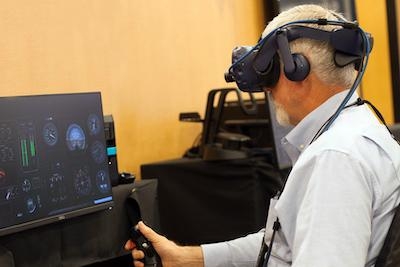
FlightSafety International has developed technology that integrates its Mixed Reality and Vital 1100 Visual Systems into Cockpit Procedures Trainers. FlightSafety is demonstrating this highly effective and cost efficient approach at the 2019 Army Aviation Mission Solutions Summit (AAAA) in Nashville, Tennessee.

“Integrating FlightSafety’s immersive Mixed Reality capability and Vital 1100 Visual System will significantly increase the effectiveness and efficiency of Cockpit Procedures Trainers,” said Jim Wheeler, General Manager, Visual Systems. “This integration can be easily performed on the majority of existing CPT’s. It will enable flight crews to complete a wide variety of training objectives that would typically be done in higher level training devices such as operational flight trainers and full flight simulators.”

Pilots will see and interact with the actual instrumentation and controls of the CPT while viewing FlightSafety’s Vital 1100 real-time imagery on a display. This is accomplished through a headset integrated with the visual system and equipped with a 3 Megapixel pass-thru camera.

Mixed Reality equipped CPT’s provide an immersive training experience that is designed to enhance and accelerate training in a variety of learning environments. They can include basic cockpit system and feature familiarization, checklist orientation, engine start procedures and simulation, malfunction identification and corrective procedures, as well as taxi maneuvers in a fixed-wing aircraft and hover in rotary wing aircraft.

These along with local area orientation and navigation, traffic patterns, and pitch and power settings, are designed to help crews learn to operate their aircraft safely within their typical operating environment.

(Image provided with FlightSafety International news release)

FMI: www.flightsafety.com

Advertisement

More News

Classic Aero-TV: Extra; the Airplane, the Man, and His Grand DeLand Plan

From 2023 (YouTube Edition): Germany’s Best by Way of Florida Established in 1980 by German aerobatic pilot Walter Extra as a means by which to design and develop his own air>[...]

ANN FAQ: Follow Us On Instagram!

Get The Latest in Aviation News NOW on Instagram Are you on Instagram yet? It's been around for a few years, quietly picking up traction mostly thanks to everybody's new obsession >[...]

Aero-News: Quote of the Day (11.27.25)

“Achieving PMA for the S-1200 Series magnetos is another step in expanding our commitment to providing the aviation community with the most trusted and durable ‘firewal>[...]

ANN's Daily Aero-Term (11.27.25): Ultralight Vehicle

Ultralight Vehicle A single-occupant aeronautical vehicle operated for sport or recreational purposes which does not require FAA registration, an airworthiness certificate, or pilo>[...]

ANN's Daily Aero-Linx (11.27.25)

Aero Linx: The de Havilland Moth Club Ltd The de Havilland Moth Club evolved from a belief that an association of owners and operators of Moth aeroplanes should be formed to create>[...]

blog comments powered by Disqus



Advertisement

Advertisement

Podcasts

Advertisement

© 2007 - 2025 Web Development & Design by Pauli Systems, LC

