
Primoco Tests Latest Version Of UAV Navigation’s Flight Control System | Aero-News Network
Aero-News Network
RSS icon RSS feed
podcast icon MP3 podcast
Subscribe Aero-News e-mail Newsletter Subscribe

Airborne Unlimited -- Most Recent Daily Episodes

Episode Date

Airborne-Monday

Airborne-Tuesday

Airborne-Wednesday Airborne-Thursday

Airborne-Friday

Airborne On YouTube

Airborne-Unlimited-12.01.25

AirborneNextGen-
12.02.25

Airborne-Unlimited-11.19.25

Airborne-AffordableFlyers-11.20.25

AirborneUnlimited-11.21.25

LIVE MOSAIC Town Hall (Archived): www.airborne-live.net

Mon, Nov 04, 2019

Primoco Tests Latest Version Of UAV Navigation’s Flight Control System

Allows Standard Runway Landings Without The Need To Install Bulky, Expensive Extra Equipment

For fixed wing UAVs operating from traditional runways, the landing maneuver is usually the most challenging and critical stage of any flight.

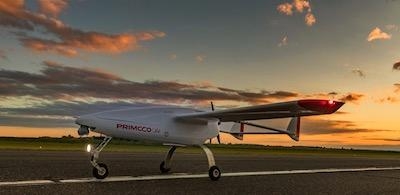
Primoco, a Czech company, has been testing the latest version of UAV Navigation’s Flight Control System (FCS) on its 330-pound fixed wing UAV. During the tests Primoco noted a number of improvements, including more efficient and advanced control, and in particular a completely automatic take-off and landing capability without using RTK or DGPS systems.

Primoco UAVs are mid-size Unmanned Aerial Vehicles that meet the complex needs of real world applications in today’s civilian market. The Primoco UAV is built to be reliable and easy to operate. It can take off and land in daylight, at night and during poor weather conditions.

UAV Navigation, a Spanish developer of advanced flight control solutions for professional UAVs, has been involved in the project from the start. Since 2016, close cooperation between the technical teams has allowed rapid development of the platform from prototype to deliverable product. UAV Navigation follows a strict philosophy of creating long-term partnerships with its clients.

UAV Navigation's FCS allows standard runway landings without the need to install bulky, expensive extra equipment, such as RTK or DGPS systems. This keeps the cost of the final product down and maximizes available payload. Using just a simple radar or laser altimeter, the autopilot is able to perform high precision landings, even in high cross-wind conditions.

The UAV Navigation autopilot controls the platform completely automatically through all modes of flight, including fully auto take-off and landing.

(Image provided with UAV Navigation news release)

FMI: www.uavnavigation.com

Advertisement

More News

ANN's Daily Aero-Term (12.01.25): Convective SIGMET

Convective SIGMET A weather advisory concerning convective weather significant to the safety of all aircraft. Convective SIGMETs are issued for tornadoes, lines of thunderstorms, e>[...]

ANN's Daily Aero-Linx (12.01.25)

Aero Linx: United Flying Octogenarians WELCOME to a most extraordinary group of aviators, the United Flying Octogenarians (UFO). Founded in 1982 with just a handful of pilots, we h>[...]

NTSB Final Report: Remos Aircraft GmbH Remos GX

Pilot’s Decision To Attempt Takeoff With Frost Covering The Airplane’s Wings Analysis: The pilot of the light sport airplane was preparing to depart for a cross-country>[...]

Aero-News: Quote of the Day (12.02.25)

“We’ve paid for the cable line’s repair for the customer and have apologized for the inconvenience this caused them...” Source: Some followup info from an A>[...]

ANN's Daily Aero-Term (12.02.25): Coupled Approach

Coupled Approach An instrument approach performed by the aircraft autopilot, and/or visually depicted on the flight director, which is receiving position information and/or steerin>[...]

blog comments powered by Disqus



Advertisement

Advertisement

Podcasts

Advertisement

© 2007 - 2025 Web Development & Design by Pauli Systems, LC

