Joint Study Suggest Feasibility
ZeroAvia, the British/American hydrogen-electric aircraft developer, announced that it has identified clear applications for hydrogen-electric, zero-emission propulsion for regional jet aircraft.
A technical study conducted in cooperation with MHIRJ—a joint venture of Mitsubishi Heavy Industries and Bombardier’s CRJ program—determined Bombardier’s CRJ-700 is an excellent candidate for retrofit with ZeroAvia’s ZA 2000RJ powertrain.
The study, which took into account factors the likes of maximum takeoff weight, center of gravity, and structural allowances, validated the fitness of other CRJ family aircraft—such as the CRJ-550 and 900—for retrofit with ZeroAvia’s propulsion scheme.
ZeroAvia’s powerplant comprises fuel-cells which generate electricity from compressed, liquid hydrogen fuel. The electricity powers electric motors which can be mated to propellers or rotors to produce thrust. ZeroAvia’s hydrogen-electric propulsion system is some five-times more powerful than any such powerplant demonstrated to date.
The hydrogen-electric CRJ aircraft would be equipped with two ZeroAvia regional jet engines—derivatives of the ZA2000 engine class—to match the performance of the CRJ’s stock GE CF34-8C5B1 high-bypass turbofan engines. Analysis suggests the ZeroAvia powerplants could support up to sixty passengers over a maximum range of 560-nautical-miles. Such performance would cover in excess of eight-percent of current CRJ-700 routes
The study identified opportunities for onboard hydrogen fuel storage and powertrain integration to ensure preservation of aircraft aerodynamics. The system would reduce operating costs by dint of hydrogen fuel use and reduced maintenance costs, thereby potentially increasing passenger volumes by enabling the creation of new routes or the operation of additional flights over extant routes.
The joint ZeroAvia - MHIRJ technical assessment concluded loss of turbine core thrust could be overcome within the constraints of the original CRJ airframe with increased fan diameter. Moreover, further efficiency gains were deemed via the adoption of novel propulsor technologies such as geared, ducted-electric-fan or open-rotor designs.
The assumptions predicated upon the phase-one study included High Temperature Proton Exchange Membrane (HTPEM) fuel cell system specific power of 2.4 kilowatts-per-kilogram. ZeroAvia previously demonstrated 2.5 kilowatts-per-kilogram at the cell-level of its HTPEM stacks. What’s more, the company plans to deliver three kilowatts-per-kilogram system level specific within two years. Such an achievement would significantly boost the performance and operational flexibility of the envisaged hydrogen-electric CRJ.

ZeroAvia CEO Val Miftakhov stated: “At this early stage in our work together, to already see a viable pathway to clean propulsion with CRJ aircraft should be absolutely thrilling to everybody who wants us to keep flying. There is some payload and range compromise, but this technical study confirms a viable propulsion architecture and integration which could be utterly transformational. Before the end of the decade airlines could be flying zero-emission jets.”
MHIRJ CEO Hiro Yamamoto remarked: “MHIRJ is proud to work with ZeroAvia and to have completed the initial study to determine the viability of hydrogen propulsion on a regional jet. Confirming that hydrogen-electric propulsion could work for an aircraft like the CRJ is a great step forward towards the decarbonization of regional flying.”
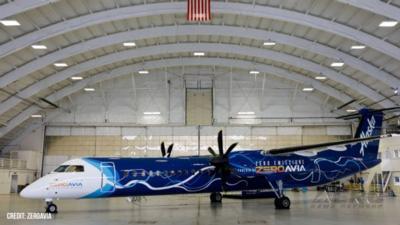
To hasten certification of its prototype ZA2000 hydrogen-electric propulsion system, ZeroAvia will presently test the architecture by retrofitting a retired 76-seat Alaska Airlines Dash 8 Q400 with such. The regional turboprop will vet the powertrain’s suitability for the more demanding regional jet application.



 ANN's Daily Aero-Term (11.28.25): Unmanned Aircraft System (UAS)


 See All