Thu, Dec 13, 2012
Air Force Officials Say The Re-Usable Spacecraft Is Designed To Be In Orbit Nine Months
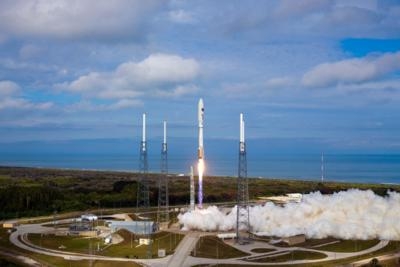
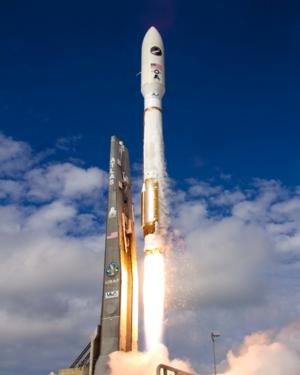
The U.S. Air Force successfully launched its third X-37B Orbital Test Vehicle December 11, officials said. The launch from Cape Canaveral's (FL) Launch Complex 41 comes on the heels of the successful flight of OTV-2, which made an autonomous landing at Vandenberg Air Force Base, CA, June 11 after a record 469 days in space.
"We couldn't be more pleased with the strides we've made in this program and the success of the X-37B vehicle on the first two flights," said Richard McKinney, Deputy Under Secretary of the Air Force for Space. "However, it is important to keep in mind that this is an experimental vehicle and a third mission is still relatively young for a test program. This is the first re-flight of a vehicle so that is certainly a key objective for us. We have only just begun what is a very systematic checkout of the system."
Lieutenant Colonel Tom McIntyre, X-37B program manager for the Air Force Rapid Capabilities Office, explained the third X-37 flight will not only help the Air Force better evaluate and understand the vehicle's performance characteristics, but this first re-flight is an important step in the program. OTV-1 launched in April 2010 and spent 224 days in orbit before going through the refurbishment process prior to being prepped for this mission, he said. "This mission will incorporate the lessons learned during the refurbishment process on OTV-1," said Lieutenant Colonel McIntyre. "As the X-37B program is examining the affordability and reusability of space vehicles, validation through testing is vital to the process. We are excited to see how this vehicle performs on a second flight."
"The X-37B OTV is designed for an on-orbit duration of approximately 9 months," said Lieutenant Colonel McIntyre. "As with previous missions, actual duration will depend on the execution of test objectives, on-orbit vehicle performance, and conditions at the landing site."
The X-37B Orbital Test Vehicle is led by the Air Force Rapid Capabilities Office, and is designed to demonstrate reusable spacecraft technologies for America's future in space and operating experiments which can be returned to, and examined, on Earth. Technologies being tested in the program include advanced guidance, navigation and control, thermal protection systems, avionics, high temperature structures and seals, conformal reusable insulation, lightweight electromechanical flight systems, and autonomous orbital flight, reentry and landing.
Officials anticipate multiple missions will be required to satisfy the test program objectives, but the exact number of missions has not been determined.
(Images provided by United Launch Alliance)
More News
How To Get A Story On Aero-TV News/Feature Programming How do I submit a story idea or lead to Aero-TV? If you would like to submit a story idea or lead, please contact Jim Campbel>[...]
“As the excitement builds for the world of flight returning to Oshkosh in 2026, we wanted to ensure that advance tickets are available for those who enjoy giving AirVenture t>[...]
North Atlantic High Level Airspace (NAT HLA) That volume of airspace (as defined in ICAO Document 7030) between FL 285 and FL 420 within the Oceanic Control Areas of Bodo Oceanic, >[...]
Also: Cosmonaut Kicked Out, Airbus Scales Back, AF Silver Star, Russian A-60 Clobbered A Samaritan’s Purse humanitarian flight was hijacked on Tuesday, December 2, while atte>[...]
Also: IAE Acquires Diamond Trainers, Army Drones, FedEx Pilots Warning, DA62 MPP To Dresden Tech Uni The danger to the flight training industry and our future pilots is clear. Dona>[...]



 ANN FAQ: Contributing To Aero-TV


 See All