
TRU Simulation + Training Qualifies Second Boeing 737 MAX FFS | Aero-News Network
Aero-News Network
RSS icon RSS feed
podcast icon MP3 podcast
Subscribe Aero-News e-mail Newsletter Subscribe

Airborne Unlimited -- Most Recent Daily Episodes

Episode Date

Airborne-Monday

Airborne-Tuesday

Airborne-Wednesday Airborne-Thursday

Airborne-Friday

Airborne On YouTube

Airborne-Unlimited-12.01.25

AirborneNextGen-
12.02.25

Airborne-Unlimited-11.19.25

Airborne-AffordableFlyers-11.20.25

AirborneUnlimited-11.21.25

LIVE MOSAIC Town Hall (Archived): www.airborne-live.net

Thu, May 04, 2017

TRU Simulation + Training Qualifies Second Boeing 737 MAX FFS

Receives Type VII Qualification From CAAS

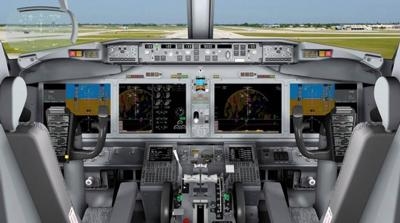
TRU Simulation + Training has completed ICAO 9625 Edition 4 Interim Type VII qualification of the Boeing 737 MAX Full Flight Simulator (FFS) by the Civil Aviation Authority of Singapore (CAAS) at the Boeing Training Campus in Singapore. The device received qualification on March 30, 2017.

The successful qualification marks the second of four 737 MAX Full Flight Simulators that TRU will deliver to Boeing’s worldwide network of training campuses this year. The first system is currently operational at Boeing’s campus in Miami, FL and is part of 10-year training agreement under which TRU will deliver multiple 737 MAX FFS suites to Boeing’s global network of training campuses.

“TRU is committed to the timely and efficient delivery and qualification of these truly world-class, state-of-the-art 737 MAX FFS suites to Boeing Training Campuses,” said George Karam, Vice President and General Manager of TRU’s Air Transport Simulation Division. “Our agreement with Boeing further enhances TRU’s position and reputation as a leading training systems supplier to global aircraft manufacturers and their airline customers.”

The 737 MAX FFS incorporates the TRU Horizon distributed I/O system that converts complex electronic signals into a single universally-used output that allows the integration of real aircraft panels without requiring modification. This innovative approach yields other advantages, including: reduced overall weight to optimize motion capabilities; requires 80 percent less wiring than traditional simulation devices; reduced simulator downtime; reduced spare parts requirements; provides a turnkey solution that is less expensive and easier to maintain.

(Source: Textron news release. Image from file)

FMI: www.textron.com

Advertisement

More News

ANN's Daily Aero-Term (12.01.25): Convective SIGMET

Convective SIGMET A weather advisory concerning convective weather significant to the safety of all aircraft. Convective SIGMETs are issued for tornadoes, lines of thunderstorms, e>[...]

ANN's Daily Aero-Linx (12.01.25)

Aero Linx: United Flying Octogenarians WELCOME to a most extraordinary group of aviators, the United Flying Octogenarians (UFO). Founded in 1982 with just a handful of pilots, we h>[...]

NTSB Final Report: Remos Aircraft GmbH Remos GX

Pilot’s Decision To Attempt Takeoff With Frost Covering The Airplane’s Wings Analysis: The pilot of the light sport airplane was preparing to depart for a cross-country>[...]

Aero-News: Quote of the Day (12.02.25)

“We’ve paid for the cable line’s repair for the customer and have apologized for the inconvenience this caused them...” Source: Some followup info from an A>[...]

ANN's Daily Aero-Term (12.02.25): Coupled Approach

Coupled Approach An instrument approach performed by the aircraft autopilot, and/or visually depicted on the flight director, which is receiving position information and/or steerin>[...]

blog comments powered by Disqus



Advertisement

Advertisement

Podcasts

Advertisement

© 2007 - 2025 Web Development & Design by Pauli Systems, LC

