

Follow That Starlifter! | Aero-News Network
Aero-News Network
RSS icon RSS feed
podcast icon MP3 podcast
Subscribe Aero-News e-mail Newsletter Subscribe

Airborne Unlimited -- Most Recent Daily Episodes

Episode Date

Airborne-Monday

Airborne-Tuesday

Airborne-Wednesday Airborne-Thursday

Airborne-Friday

Airborne On YouTube

Airborne-SpecialEpisode-12.15.25

AirborneNextGen-
12.16.25

Airborne-Unlimited-12.10.25

Airborne-AffordableFlyers-12.11.25

AirborneUnlimited-12.12.25

AFE 2025 LIVE MOSAIC Town Hall (Archived): www.airborne-live.net

Wed, Jun 25, 2003

Follow That Starlifter!

C-141 Guides Lost Convair

A C-141 Starlifter aircrew from March Air Reserve Base (CA) led three people on a civilian cargo aircraft to safety after an apparent navigational-equipment malfunction caused them to become disoriented in bad weather off the coast of New Zealand.

"They appeared to have no reliable navigational fix," navigator Maj. Jeff Puckett told a TV news crew. "That’s not a good place to be over the South Pacific."

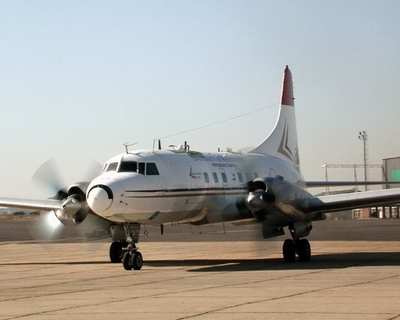
The two Canadian pilots and a New Zealander engineer were flying a twin-engine Convair 580 (file photo below) from American Samoa to New Zealand on June 18 when air traffic controllers became concerned the aircraft had not appeared on their radar 20 minutes before its scheduled landing.

The controllers contacted the plane but lost the connection before determining its location. Officials at the National Rescue Coordination Center in Wellington launched a rescue effort and contacted the March reservists, who were on their way to Christchurch, New Zealand, to participate in aircraft software testing. The aircrew from the 452nd Air Mobility Wing flew east and within an hour made contact with the aircraft about 250 nautical miles off the country’s coast.

"The sound of their voices indicated they were very happy to see our aircraft," said Lt. Col. Jeffrey Richenberger, the C-141 pilot.

The Air Force Reserve Command crew directed the civilian pilot to turn on his emergency locator beacon, and they escorted the aircraft to a safe landing at Gisborne, New Zealand.

A malfunction apparently led the civilian crew off course during their flight. They knew they were in trouble when their instruments said they were over New Zealand but all they could see was the Pacific Ocean, the crew said.

[Thanks to Staff Sgt. Kristin Mack, 452nd Air Mobility Wing Public Affairs, and AFRC News Service --ed.]

FMI: www.af.mil/factsheets/factsheet.asp?fsID=93

Advertisement

More News

ANN's Daily Aero-Term (12.19.25): Ultrahigh Frequency (UHF)

Ultrahigh Frequency (UHF) The frequency band between 300 and 3,000 MHz. The bank of radio frequencies used for military air/ground voice communications. In some instances this may >[...]

NTSB Prelim: Cirrus Design Corp SR22T

During The 7 Second Descent, There Was Another TAWS Alert At Which Time The Engine Remained At Full Power On October 24, 2025 at 2115 mountain daylight time, a Cirrus SR22T, N740TS>[...]

Classic Aero-TV: The Red Tail Project--Carrying the Torch of the Tuskegee Airmen

From 2009 (YouTube Edition): Educational Organization Aims to Inspire by Sharing Tuskegee Story Founding leader Don Hinz summarized the Red Tail Project’s mission in simple, >[...]

Aero-News: Quote of the Day (12.19.25)

“This feels like an important step since space travel for people with disabilities is still in its very early days... I’m so thankful and hope it inspires a change in m>[...]

Airborne 12.17.25: Skydiver Hooks Tail, Cooper Rotax Mount, NTSB v NDAA

Also: New Katanas, Kern County FD Training, IndiGo’s Botched Roster, MGen. Leavitt Named ERAU Dean The Australian Transportation Safety Bureau (ATSB) has wrapped up its inves>[...]

blog comments powered by Disqus



Advertisement

Advertisement

Podcasts

Advertisement

© 2007 - 2025 Web Development & Design by Pauli Systems, LC

