
Airman Missing In Action From Vietnam War Identified | Aero-News Network
Aero-News Network
RSS icon RSS feed
podcast icon MP3 podcast
Subscribe Aero-News e-mail Newsletter Subscribe

Airborne Unlimited -- Most Recent Daily Episodes

Episode Date

Airborne-Monday

Airborne-Tuesday

Airborne-Wednesday Airborne-Thursday

Airborne-Friday

Airborne On YouTube

Airborne-Unlimited-12.01.25

AirborneNextGen-
12.02.25

Airborne-Unlimited-11.19.25

Airborne-AffordableFlyers-11.20.25

AirborneUnlimited-11.21.25

LIVE MOSAIC Town Hall (Archived): www.airborne-live.net

Sat, Apr 04, 2009

Airman Missing In Action From Vietnam War Identified

Was Unable To Eject From Stricken F-4D Phantom

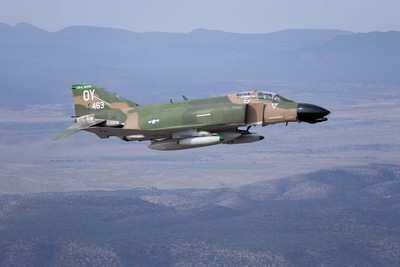
The Department of Defense POW/Missing Personnel Office (DPMO) announced this week the remains of a US airman, missing in action from the Vietnam War, have been identified and will be returned to his family for burial with full military honors.

Lt. Col. Earl P. Hopper Jr., US Air Force, of Phoenix, AZ will be buried on April 3 at the National Memorial Cemetery of Arizona in Phoenix.

On January 10, 1968, Hopper and Capt. Keith Hall were flying an F-4D Phantom near Hanoi, North Vietnam, as part of a four-ship MiG combat air patrol. Before they reached the target, an enemy surface-to-air missile exploded slightly below their aircraft.

Hall radioed that he and Hopper were ejecting. He told Hopper to eject, but when he heard no response, he repeated "Earl get out!" Hopper replied, "I've pulled on it and it [the ejection seat] did not go," followed by "you go!" Hall then pulled on his primary ejection handle but it failed to initiate, forcing him to use the alternate.

Hall was captured and held as a prisoner of war until 1973, but Hopper was unable to get out of the aircraft.

Between 1993-1998, the Joint POW/MIA Accounting Command (JPAC) conducted three joint investigations and five excavations at the crash site in Son La Province, west of Hanoi. The team interviewed four informants who had knowledge of the site.

The excavations recovered numerous skeletal fragments and crew-related items which were ultimately used in the forensic identification process. Among other forensic tools and circumstantial evidence, scientists used extensive dental comparisons in the identification of the remains.

FMI: www.dtic.mil/dpmo

Advertisement

More News

ANN's Daily Aero-Term (12.01.25): Convective SIGMET

Convective SIGMET A weather advisory concerning convective weather significant to the safety of all aircraft. Convective SIGMETs are issued for tornadoes, lines of thunderstorms, e>[...]

ANN's Daily Aero-Linx (12.01.25)

Aero Linx: United Flying Octogenarians WELCOME to a most extraordinary group of aviators, the United Flying Octogenarians (UFO). Founded in 1982 with just a handful of pilots, we h>[...]

NTSB Final Report: Remos Aircraft GmbH Remos GX

Pilot’s Decision To Attempt Takeoff With Frost Covering The Airplane’s Wings Analysis: The pilot of the light sport airplane was preparing to depart for a cross-country>[...]

Aero-News: Quote of the Day (12.02.25)

“We’ve paid for the cable line’s repair for the customer and have apologized for the inconvenience this caused them...” Source: Some followup info from an A>[...]

ANN's Daily Aero-Term (12.02.25): Coupled Approach

Coupled Approach An instrument approach performed by the aircraft autopilot, and/or visually depicted on the flight director, which is receiving position information and/or steerin>[...]

blog comments powered by Disqus



Advertisement

Advertisement

Podcasts

Advertisement

© 2007 - 2025 Web Development & Design by Pauli Systems, LC

