Scientists Analyzing Why Oumuamua Suddenly Gained Speed
Using observations from NASA’s Hubble Space Telescope and ground-based observatories, an international team of scientists have confirmed ′Oumuamua, the first known interstellar object to travel through our solar system, got an unexpected boost in speed and shift in trajectory as it passed through the inner solar system last year.
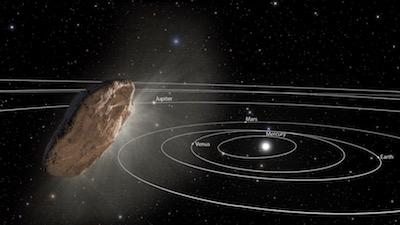
“Our high-precision measurements of ′Oumuamua’s position revealed that there was something affecting its motion other than the gravitational forces of the Sun and planets," said Marco Micheli of ESA’s (European Space Agency) Space Situational Awareness Near-Earth Object Coordination Centre in Frascati, Italy, and lead author of a paper describing the team's findings.
Analyzing the trajectory of the interstellar visitor, co-author Davide Farnocchia of the Center for Near Earth Object Studies (CNEOS) at NASA’s Jet Propulsion Laboratory (JPL) found that the speed boost was consistent with the behavior of a comet. “This additional subtle force on ′Oumuamua likely is caused by jets of gaseous material expelled from its surface,” said Farnocchia. “This same kind of outgassing affects the motion of many comets in our solar system.”
Comets normally eject large amounts of dust and gas when warmed by the Sun. But according to team scientist Olivier Hainaut of the European Southern Observatory, “there were no visible signs of outgassing from ′Oumuamua, so these forces were not expected.”
The team estimates that ′Oumuamua’s outgassing may have produced a very small amount of dust particles – enough to give the object a little kick in speed, but not enough to be detected.
Karen Meech, an astronomer at the University of Hawaii’s Institute of Astronomy and co-author of the study, speculated that small dust grains, present on the surface of most comets, eroded away during ′Oumuamua's long journey through interstellar space. "The more we study ′Oumuamua, the more exciting it gets," Meech said. "I'm amazed at how much we have learned from a short, intense observing campaign. I can hardly wait for the next interstellar object!"
′Oumuamua, less than half a mile in length, now is farther away from our Sun than Jupiter and traveling away from the Sun at about 70,000 mph as it heads toward the outskirts of the solar system. In only another four years, it will pass Neptune’s orbit on its way back into interstellar space.
Because ′Oumuamua is the first interstellar object ever observed in our solar system, researchers caution that it’s difficult to draw general conclusions about this newly-discovered class of celestial bodies. However, observations point to the possibility that other star systems regularly eject small comet-like objects and there should be more of them drifting among the stars. Future ground- and space-based surveys could detect more of these interstellar vagabonds, providing a larger sample for scientists to analyze.
The international team of astronomers used observations from Hubble, the Canada-France-Hawaii Telescope in Hawaii, and the Gemini South Telescope and European Southern Observatory's Very Large Telescope in Chile.
The paper with the team’s findings appeared in the June 27 issue of the journal Nature.
(Image provided with NASA news release)



 ANN's Daily Aero-Term (12.01.25): Convective SIGMET


 See All