

NASA Decommissions Its Galaxy Hunter Spacecraft | Aero-News Network
Aero-News Network
RSS icon RSS feed
podcast icon MP3 podcast
Subscribe Aero-News e-mail Newsletter Subscribe

Airborne Unlimited -- Most Recent Daily Episodes

Episode Date

Airborne-Monday

Airborne-Tuesday

Airborne-Wednesday Airborne-Thursday

Airborne-Friday

Airborne On YouTube

Airborne-Unlimited-12.01.25

AirborneNextGen-
12.02.25

Airborne-Unlimited-11.19.25

Airborne-AffordableFlyers-11.20.25

AirborneUnlimited-11.21.25

LIVE MOSAIC Town Hall (Archived): www.airborne-live.net

Wed, Jul 03, 2013

NASA Decommissions Its Galaxy Hunter Spacecraft

Space Telescope Has Searched Across 10 Billion Years Of Cosmic Time

NASA has turned off its Galaxy Evolution Explorer (GALEX) after a decade of operations in which the venerable space telescope used its ultraviolet vision to study hundreds of millions of galaxies across 10 billion years of cosmic time.

"GALEX is a remarkable accomplishment," said Jeff Hayes, NASA's GALEX program executive in Washington. "This small Explorer mission has mapped and studied galaxies in the ultraviolet, light we cannot see with our own eyes, across most of the sky."

Operators at Orbital Sciences Corporation in Dulles, VA, sent the signal to decommission GALEX at 1509 EDT Friday, June 28. The spacecraft will remain in orbit for at least 65 years, then fall to Earth and burn up re-entering the atmosphere. GALEX met its prime objectives and its mission was extended three times before NASA decided to end it.

Highlights from the mission's decade of sky scans include:

  • The discovery of a gargantuan comet-like tail behind a speeding star called Mira.
  • Catching a black hole "red-handed" as it munched on a star.
  • Finding giant rings of new stars around old, dead galaxies.
  • Independently confirming the nature of dark energy.
  • The discovery of a missing link in galaxy evolution -- the teenage galaxies transitioning from young to old.
  • The mission also captured a dazzling collection of snapshots, showing everything from ghostly nebulas to a spiral galaxy with huge, spidery arms.

In a first-of-a-kind move for NASA, the agency in May 2012 loaned GALEX to Caltech, which used private funds to continue operating the satellite while NASA retained ownership. Since then, investigators from around the world have used GALEX to study everything from stars in our own Milky Way galaxy to hundreds of thousands of galaxies 5 billion light-years away.

In the space telescope's last year, it scanned across large patches of sky, including the bustling, bright center of our Milky Way. The telescope spent time staring at some areas of the sky exploded stars, called supernovae, and monitoring how objects, such as the centers of active galaxies, change over time. GALEX also scanned the sky for massive, feeding black holes and shock waves from early supernova explosions.

Data from the last year of the mission will be made public in the coming year.

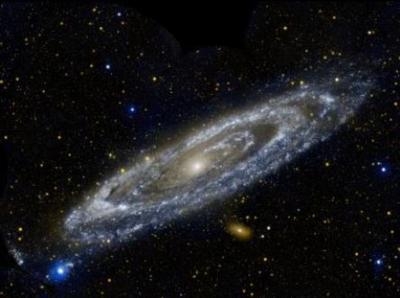
(GALEX image of the Andromeda galaxy provided by NASA)

FMI: www.nasa.gov/galex

Advertisement

More News

ANN's Daily Aero-Term (11.29.25): Waypoint

Waypoint A predetermined geographical position used for route/instrument approach definition, progress reports, published VFR routes, visual reporting points or points for transiti>[...]

ANN's Daily Aero-Linx (11.29.25)

Aero Linx: Sentimental Journey to Cub Haven Sentimental Journey Flyin began in 1986 with a group of dedicated volunteers working to provide a sentimental return to Lock Haven, the >[...]

NTSB Prelim: Jabiru USA Sport Aircraft LLC J230-SP

The Pilot Would Often Fly Over Their House At A Low Altitude And That Family Members Would Go Outside To Wave On November 14, 2025, at 1708 eastern standard time, a Jabiru USA Spor>[...]

Classic Aero-TV: Crafting The Future of eVTOL Infrastructure

From 2024 (YouTube Edition): Volatus Infrastructure Paves The Way The name “Volatus” seems to be everywhere these days, popping up in a series of partnerships and proje>[...]

Klyde Morris (11.28.25)

Fortnite Conquers All, Klyde FMI: www.klydemorris.com>[...]

blog comments powered by Disqus



Advertisement

Advertisement

Podcasts

Advertisement

© 2007 - 2025 Web Development & Design by Pauli Systems, LC

