Cassini Images Show Evidence Of Violent Past
First images from the Cassini flyby of Saturn's moon, Phoebe,
reveal it to be a scarred, cratered outpost with a very old surface
and a mysterious past, and a great deal of variation in surface
brightness across its surface.
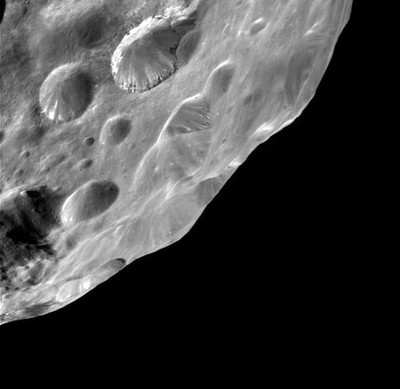
"What spectacular images," said Dr. Carolyn Porco, Cassini
Imaging Team leader at the Space Science Institute in Boulder (CO).
"So sharp and clear and showing a great many geological features,
large and small. It's obvious a lot of new insights into the origin
of this strange body will come as a result of all this."
"What we are seeing is very neat. Phoebe is a heavily cratered
body. We might be seeing one of the chunks from the formation of
the solar system, 4.5 billion years ago. It's too soon to say,"
said Dr. Torrence Johnson, Cassini imaging team member at NASA's
Jet Propulsion Laboratory, Pasadena (CA). "It's important to see
the big picture from all of the other instruments to get the global
view on this tiny moon."
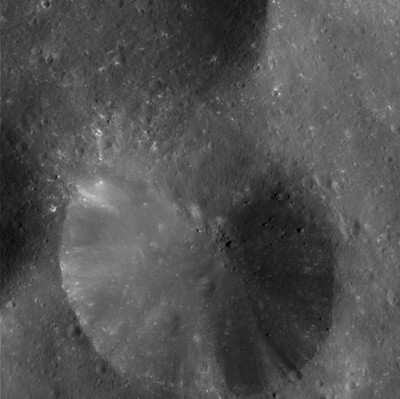
Dr. Gerhard Neukum, an imaging team member from Freie University
in Berlin, said, "It is very interesting and quite clear that a lot
of craters smaller than a kilometer are visible. This means,
besides the big-ones, lots of projectiles smaller than 100 meters
(328 feet) have hit Phoebe." Whether these projectiles came from
outside or within the Saturn system is debatable.
There is a suspicion that Phoebe, the largest of Saturn's outer
moons, might be parent to the other, much smaller retrograde outer
moons that orbit Saturn.
Dr. Joseph Burns, an imaging team member and professor at
Cornell University, Ithaca, N.Y. said, "Looking at those big 50
kilometers (31 mile) craters, one has to wonder whether their
impact ejecta might be the other tiny moons that orbit Saturn on
paths much like Phoebe's."
All planned 11 instruments operated as expected and all data was
acquired. Scientists plan to use the data to create global maps of
the cratered moon, and to determine Phoebe's composition, mass and
density. It will take scientists several days to pour over the data
to make more concrete conclusions.
Cassini came within approximately 2,068 kilometers (about 1,285
miles) of the dark moon on Friday, June 11. The spacecraft was
pointing its instruments at the moon during the flyby. Several
hours later it turned to point its antenna to Earth. The signal was
received through the Deep Space Network antennas in Madrid, Spain
and Goldstone, in California's Mojave Desert, at 7:52 a.m. PDT
today. Cassini was traveling at a relative speed of 20,900
kilometers per hour (13,000 miles per hour) relative to Saturn.
It's been 23 years since a spacecraft last visited Phoebe. The
Voyager 2 flyby in 1981 was at a distance from 2.2 million
kilometers, (about 1.4 million miles), 1,000 times farther
away.
With the Phoebe flyby accomplished, Cassini is on course for
Saturn. A trajectory correction maneuver is scheduled for June 16.
Cassini will conduct a critical 96-minute burn before going into
orbit around Saturn on June 30 (July 1 Universal Time). During
Cassini's planned four-year tour it will conduct 76 orbits around
the Saturn system and execute 52 close encounters with seven of
Saturn's 31 known moons.



 ANN's Daily Aero-Linx (12.12.25)


 See All