Scientific Marvel Or Political Hail Mary?
It struck awe around the world and fear around the Pentagon.
Fifty years ago this Thursday, Russia launched the first tiny probe
that ignited a decades-long space race -- Sputnik.
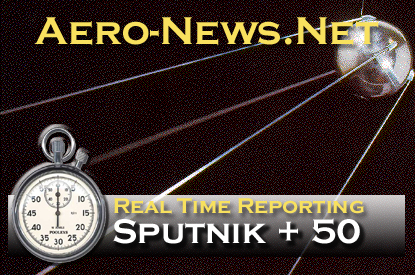
Roughly the size of a basketball, the antenna-spiked sphere was,
in 1957, the first man-made object ever hurled into Earth orbit. It
was touted as the pinnacle of Soviet scientific achievement, an
early win in the space race.
Or was it?
"The key reason behind the emergence of Sputnik was the Cold War
atmosphere and our race against the Americans," Boris Chertok tells
the Associated Press. He's 95-years old now. But in 1957, Chertok
was one of the two fathers of Sputnik. "The military missile was
the main thing we were thinking of at the moment."
Indeed, the cold war was near its zenith. The focus of Soviet
military technology was getting a missile-borne hydrogen bomb over
the United States. The Soviets had the rocket -- the R-7. With
plenty of thrust (the Russians hadn't yet figured out the warhead
configuration for their hydrogen bomb, so they weren't sure how
much it would weigh), but they as yet had no payload.
That gave Chertok and scientist Sergei Korolyov a unique
opportunity. The Kremlin had a rocket. And, since the military
couldn't come up with a weapon payload right away, Chertok and
Korolyov rummaged through their storehouse of ideas for a space
satellite. Sure, they had one on the drawing board, but they needed
something much quicker. So they formed a team that quickly came up
with PS-1 -- "Prosteishiy Sputnik-1." Literally, it was the
Simplest Satellite.
In three months, they had a working model. PS-1 was a round
sphere of polished aluminum. Inside, the sphere contained a radio
transmitter.
Chertok remembers his boss, Korolyov, telling him, "The Earth is
a sphere, and its first satellite also must have a spherical
shape."
Inside, the pressurized sphere contained a radio transmitter.
Outside, Sputnik was surrounded by four long antennae.
Sputnik was originally set to launch on October 6, 1957. But
Korolyov was worried that the US was moving up its plans for a
missile launch, all evidence pointing to the contrary. So he
canceled some last-minute tests and put the tiny satellite on the
launch pad atop its R-7 rocket.
"Better than anyone else Korolyov understood how important it
was to open the space era," 76-year old Georgy Grechko tells the
AP. Back then he was a rocket scientist. Later, he became a
cosmonaut. "The Earth had just one moon for a billion years and
suddenly it would have another, artificial moon!"
Important, indeed. Slow to grasp the monumental importance of
Sputnik's feeble radio beeps, Korolyov's team realized what they'd
done inside a week.
"At that moment we couldn't fully understand what we had done,"
Chertok tells the wire service. "We felt ecstatic about it only
later, when the entire world ran amok. Only four or five days later
did we realize that it was a turning point in the history of
civilization."
Did your folks ever tell you of lying in the grass that fall,
watching Sputnik as it circled the planet every 98 minutes?
The were wrong. Instead, they were watching the spent
second-stage booster, which was in roughly the same orbit. Sputnik
was far too small to see with the naked eye.
The Kremlin was quickly thrilled. Premier Nikita Khrushchev
quickly ordered Korolyov to send up another satellite -- and he
wanted it orbiting the Earth in less than a month to mark the
November 17, 1917 Communist revolution.
Korolyov complied. His team worked 'round the clock to come up
with Sputnik-2, a much larger spacecraft with a pressurized cabin.
It launched November 3, 1957, carrying the first Earth creature
into orbit -- a mixed-breed dog named Laika. That animal died of
heat exhaustion in the capsule a few days after launch.
Sputnik-1 stopped beeping three weeks after its launch. Its
orbit decayed and it burned up in the atmosphere after three weeks.
But with the International Space Station now circling the Earth and
manned missions being planned for both the Moon and Mars, its
creation and its legacy are well worth remembering.



 ANN FAQ: Contributing To Aero-TV


 See All