Mon, Aug 21, 2023
Dawn of the Transonic Truss-Braced Wing
Boeing is making ready to modify an MD-90 narrow-body airliner—transforming the machine radically for purpose of testing the company’s Transonic Truss-Braced Wing (TTBW) architecture under the auspices of NASA's Sustainable Flight Demonstrator project.
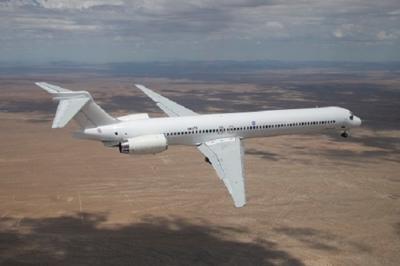
Upon completion of an extensive series of structural modifications, the MD-90 will emerge as the X-66A.
As Boeing, NASA, and community leaders gathered to recognize the milestone occasioned by the undertaking of the X-66A project, Boeing released photos of the MD-90’s journey from Victorville to Palmdale, California.
The X-66A is NASA's first full-sized experimental airplane designed specifically to advance the international community’s goal of net-zero aviation greenhouse gas emissions. Modification of the MD-90 will commence presently; ground and flight-testing are expected to begin in 2028.
Boeing Chief Technology Officer Todd Citron stated: "This marks an important step in the Sustainable Flight Demonstrator project, advances Boeing's commitment to sustainability and brings us closer to testing and validating the TTBW design.”
With ultrathin wings braced by struts with larger spans and higher-aspect ratios, the TTBW design and other expected technological advances could lead to reductions in fuel use and emissions by up to thirty-percent. Boeing and NASA have collaborated for more than a decade on the concept through the Subsonic Ultra Green Aircraft Research (SUGAR) Program.
Ed Waggoner, deputy associate administrator for programs in the NASA Aeronautics Research Mission Directorate, remarked: "We at NASA are excited to be working with Boeing on the X-66A Sustainable Flight Demonstrator making critical contributions to accelerate aviation towards its 2050 net-zero greenhouse gas emission goal.”
California Congressman Mike Garcia opined: "Aerospace Valley has a long and distinguished history as the cradle of aerospace innovation, and this unveiling is a continuation of that critical work. Palmdale's talented workforce and infrastructure make it the perfect location for this important project.”
More News
“We respectfully call on the City of Mesa to: 1. Withdraw the landing fee proposal immediately 2. Engage with the aviation community before making decisions that impact safet>[...]
High Speed Taxiway A long radius taxiway designed and provided with lighting or marking to define the path of aircraft, traveling at high speed (up to 60 knots), from the runway ce>[...]
Aero Linx: International Federation of Airworthiness (IFA) IFA uniquely combines together all those with responsibility for policies, principles and practices concerned with the co>[...]
Controller’s Expectation That VW02 Would Have Departed Sooner Led To An Inadequate Scan And Loss Of Situational Awareness Analysis: A Robinson R-44 helicopter N744AF, VW02 (V>[...]
A Few Questions AND Answers To Help You Get MORE Out of ANN! 1) I forgot my password. How do I find it? 1) Easy... click here and give us your e-mail address--we'll send it to you >[...]



 Aero-News: Quote of the Day (12.09.25)


 See All