
Student Experiments Soar With Early Morning Launch From Wallops | Aero-News Network
Aero-News Network
RSS icon RSS feed
podcast icon MP3 podcast
Subscribe Aero-News e-mail Newsletter Subscribe

Airborne Unlimited -- Most Recent Daily Episodes

Episode Date

Airborne-Monday

Airborne-Tuesday

Airborne-Wednesday Airborne-Thursday

Airborne-Friday

Airborne On YouTube

Airborne-Unlimited-12.08.25

AirborneNextGen-
12.02.25

Airborne-Unlimited-12.03.25

Airborne-FltTraining-12.04.25

AirborneUnlimited-12.05.25

AFE 2025 LIVE MOSAIC Town Hall (Archived): www.airborne-live.net

Sat, Aug 18, 2018

Student Experiments Soar With Early Morning Launch From Wallops

About 100 Students Witness Suborbital Sounding Rocket Launch

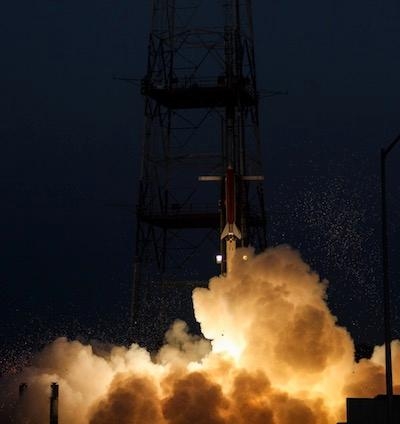
Approximately 100 undergraduate university and community college students from across the United States were on hand to witness the launch of their experiments and technology demonstration projects on a NASA suborbital rocket at 6:13 a.m., Aug. 14, from NASA’s Wallops Flight Facility.

The Terrier-Improved Malemute sounding rocket launched as the sun was rising over the horizon and carried the student projects to an altitude of 98.5 miles.

After a brief ride into space, the payload carrying the students’ projects descended by parachute and landed in the Atlantic Ocean approximately 64 miles from the launch site. After recovery, the experiments will be returned to the students later in the day.

The eight experiments developed by students from across the country flew through the RockSat-X program in conjunction with the Colorado Space Grant Consortium. RockSat-X is the most advanced of NASA’s three-phase sounding rocket program for students.  The RockOn launches are at the entry level, then progress to the intermedia level RockSat-C missions and then RockSat-X.

Also joining the RockSat-X students for the launch were about 50 students participating in the RockSat-XN program who are at Wallops preparing their experiment projects for flight. Similar to RockSat-X, XN includes experiments developed by students in the United States and those from universities in Norway and Japan.

XN is launching in January 2019 from the Andoya Space Center in Norway as part of an international project called the Grand Challenge Initiative (GCI) – Cusp.

In the GCI, NASA and United States scientists will join those from Norway, Japan, Canada and other countries during the next two years to investigate the region called the geomagnetic cusp — one of the few places on Earth with easy access to the electrically charged solar wind that pervades the solar system. The coordinated studies of near-Earth space at the Polar Regions will help understand the fundamental processes of our neighborhood in space; such knowledge is needed for safe navigation and communication near the poles, where solar activity can disrupt radio signals.

(Image provided with NASA news release)

FMI: www.nasa.gov

Advertisement

More News

NTSB Final Report: Patriot Aircraft LLC CX1900A

After Draining Both Wing Fuel Tanks, A Significant Amount Of Water Was Observed In The Right Wing Fuel Tank Analysis: The pilot, who was also the owner of the experimental amateur->[...]

Aero-News: Quote of the Day (12.06.25)

“Airbus apologises for any challenges and delays caused to passengers and airlines by this event. The Company thanks its customers, the authorities, its employees and all rel>[...]

ANN's Daily Aero-Term (12.06.25): High Speed Taxiway

High Speed Taxiway A long radius taxiway designed and provided with lighting or marking to define the path of aircraft, traveling at high speed (up to 60 knots), from the runway ce>[...]

ANN's Daily Aero-Linx (12.06.25)

Aero Linx: Taylorcraft Foundation, Inc. The Taylorcraft Foundation is exclusively organized for charitable, educational & scientific activities and will preserve the history an>[...]

Airborne-NextGen 12.02.25: Honda eVTOL, Arctus High-Alt UAS, Samson Patent

Also: USAF Reaper Accident, Baikonur Damage, Horizon eVTOL IFR/FIKI, New Glenn Update Honda has outlined its clearest timeline yet for its entry into the world of electric vertical>[...]

blog comments powered by Disqus



Advertisement

Advertisement

Podcasts

Advertisement

© 2007 - 2025 Web Development & Design by Pauli Systems, LC

