

Shuttle Probably Won't Fly Again Until November | Aero-News Network
Aero-News Network
RSS icon RSS feed
podcast icon MP3 podcast
Subscribe Aero-News e-mail Newsletter Subscribe

Airborne Unlimited -- Most Recent Daily Episodes

Episode Date

Airborne-Monday

Airborne-Tuesday

Airborne-Wednesday Airborne-Thursday

Airborne-Friday

Airborne On YouTube

Airborne-Unlimited-12.08.25

AirborneNextGen-
12.09.25

Airborne-Unlimited-12.10.25

Airborne-AffordableFlyers-12.11.25

AirborneUnlimited-12.12.25

AFE 2025 LIVE MOSAIC Town Hall (Archived): www.airborne-live.net

Fri, Aug 12, 2005

Shuttle Probably Won't Fly Again Until November

Engineers Trying To Tackle Foam Problem

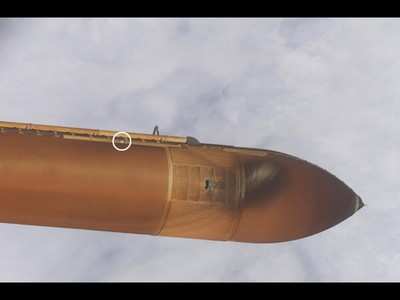
NASA scientists and engineers, still stumped by the falling foam that killed Columbia and threatened Discovery on its Return to Flight, say the next shuttle mission will likely be delayed until November.

Space agency officials had hoped they would be able to launch Atlantis next month. But the delamination of foam from the external fuel tank continues to plague the shuttle program, even after the tank was redesigned.

"We didn't find any root cause" of the foam incident, said William Gerstenmeier, program manager of the International Space Station. "It was probably a combination of events. We just need to keep looking." Gerstenmeier was quoted by the Washington Post.

Gerstenmeier told reporters in a teleconference Thursday that foam has been falling from the external fuel tank during shuttle launches that date back to the very first mission in 1981. But until the Columbia tragedy, no one thought falling foam could cripple -- or kill -- the orbiter, he said.

Since the Columbia tragedy, NASA has spent thousands of man-hours and hundreds of millions of dollars trying to eradicate the problem. In the Return to Flight mission, they thought they had the problem licked... until a 0.9 pound piece of foam fell from the tank during launch. It was the largest chunk of foam to fall off, but Gerstenmeier said there were other incidents of delamination as well.

The initial thought at NASA is that, since the largest piece of foam to come off the tank fell from a spot that had been sprayed by hand, new machinery might be developed to ensure a more even application of the insulating material. But some of the areas that became delaminated were machine-sprayed, leaving NASA engineers at the Marshall Space Flight Center back at the drawing board.

"This is a very difficult engineering problem," Gerstenmeier said.

Five teams have now been assigned to find a way to stop falling foam. Gerstenmeier told reporters he hoped to have a solution in the next couple of weeks.

FMI: www.nasa.gov

Advertisement

More News

ANN's Daily Aero-Linx (12.12.25)

Aero Linx: Commercial Aviation Safety Team (CAST) Founded in 1997, the Commercial Aviation Safety Team (USCAST) has developed an integrated, data-driven strategy to reduce the comm>[...]

ANN's Daily Aero-Term (12.12.25): Land And Hold Short Operations

Land And Hold Short Operations Operations that include simultaneous takeoffs and landings and/or simultaneous landings when a landing aircraft is able and is instructed by the cont>[...]

ANN FAQ: How Do I Become A News Spy?

We're Everywhere... Thanks To You! Even with the vast resources and incredibly far-reaching scope of the Aero-News Network, every now and then a story that should be reported on sl>[...]

NTSB Final Report: Cirrus Design Corp SF50

Pilot’s Inadvertent Use Of The Landing Gear Control Handle Instead Of The Flaps Selector Switch During The Landing Rollout Analysis: The pilot reported that during the landin>[...]

Airborne 12.08.25: Samaritan’s Purse Hijack, FAA Med Relief, China Rocket Fail

Also: Cosmonaut Kicked Out, Airbus Scales Back, AF Silver Star, Russian A-60 Clobbered A Samaritan’s Purse humanitarian flight was hijacked on Tuesday, December 2, while atte>[...]

blog comments powered by Disqus



Advertisement

Advertisement

Podcasts

Advertisement

© 2007 - 2025 Web Development & Design by Pauli Systems, LC

