Fri, Aug 09, 2013
Second Launch Less Than Three Months Carried Out By ULA
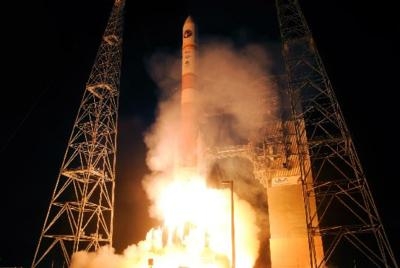
A Delta IV rocket successfully launched the sixth Wideband Global SATCOM (WGS-6) satellite for the U.S. Air Force at 8:29 p.m. EDT Wednesday from Space Launch Complex-37 in Florida. This is the seventh launch for United Launch Alliance (ULA) in 2013, the 73rd launch since the company was formed in December 2006, and the second WGS mission launch this year.
"Congratulations to the entire team on today's successful launch of the WGS-6 satellite. As with the previous five WGS missions, we have enjoyed a very strong partnership with the Air Force and all of our missions partners throughout this launch campaign," said Jim Sponnick, ULA vice president, Atlas and Delta Programs. "We were honored to launch the first two WGS satellites on our Atlas V vehicle and the next four satellites in the constellation on our Delta IV vehicle, delivering critical communications capability to orbit to support our nation's warfighters throughout the world."
This mission was launched aboard a Delta IV Medium-plus configuration vehicle using a single ULA common booster core powered by an Aerojet Rocketdyne RS-68 main engine, along with four ATK GEM 60 solid rocket motors. The five-meter diameter upper stage was powered by an Aerojet Rocketdyne RL10B-2 engine with the satellite encapsulated in a five-meter diameter composite payload fairing. The WGS-6 launch marked the fourth flight of the Delta IV medium+ (5,4) configuration and the 23rd flight of the Delta IV family of launch vehicles. Wideband Global SATCOM provides anytime, anywhere communication for the warfighter through broadcast, multicast, and point to point connections. WGS is the only military satellite communications system that can support simultaneous X and Ka band communications.
ULA's next launch is the Delta IV Heavy NROL-65 mission for the National Reconnaissance Office scheduled on Aug. 28, from Space Launch Complex-6 at Vandenberg Air Force Base, CA.
The EELV program was established by the United States Air Force to provide assured access to space for Department of Defense and other government payloads. The commercially developed EELV Program supports the full range of government mission requirements, while delivering on schedule and providing significant cost savings over the heritage launch systems.
(Image provided by United Launch Alliance)
More News
Decision Altitude (DA) A specified altitude (mean sea level (MSL)) on an instrument approach procedure (ILS, GLS, vertically guided RNAV) at which the pilot must decide whether to >[...]
Aero Linx: T-34 Association, Inc. The T-34 Association was formed in July 1975 so that individuals purchasing then military surplus T-34As had an organization which would provide s>[...]
As He Released The Brakes To Begin Taxiing, The Brake Pedals Went To The Floor With No Braking Action Analysis: The pilot reported that during engine start up, he applied the brake>[...]
“Legislation like the Mental Health in Aviation Act is still imperative to hold the FAA accountable for the changes they clearly acknowledge need to be made... We cannot wait>[...]
Also: IAE Acquires Diamond Trainers, Army Drones, FedEx Pilots Warning, DA62 MPP To Dresden Tech Uni The danger to the flight training industry and our future pilots is clear. Dona>[...]



 ANN's Daily Aero-Term (12.08.25): Decision Altitude (DA)


 See All