
NASA Developing Legs For Space Station's Robonaut 2 | Aero-News Network
Aero-News Network
RSS icon RSS feed
podcast icon MP3 podcast
Subscribe Aero-News e-mail Newsletter Subscribe

Airborne Unlimited -- Most Recent Daily Episodes

Episode Date

Airborne-Monday

Airborne-Tuesday

Airborne-Wednesday Airborne-Thursday

Airborne-Friday

Airborne On YouTube

Airborne-Unlimited-12.08.25

AirborneNextGen-
12.09.25

Airborne-Unlimited-12.10.25

Airborne-AffordableFlyers-12.11.25

AirborneUnlimited-12.12.25

AFE 2025 LIVE MOSAIC Town Hall (Archived): www.airborne-live.net

Sun, Dec 15, 2013

NASA Developing Legs For Space Station's Robonaut 2

Will Provide Mobility For 'R2' To Complete Regular, Repetitive Tasks

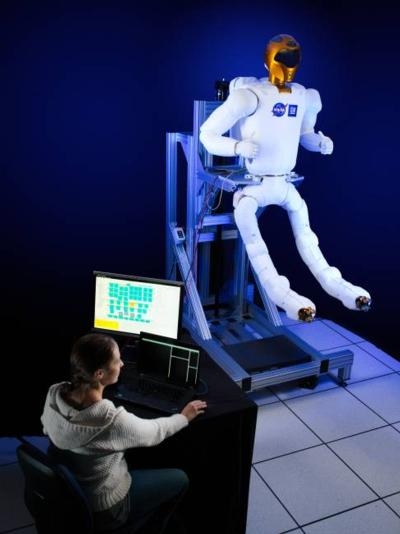
NASA engineers are developing climbing legs for the International Space Station's robotic crewmember Robonaut 2 (R2), marking another milestone in space humanoid robotics. The legless R2, currently attached to a support post, is undergoing experimental trials with astronauts aboard the orbiting laboratory. Since its arrival at the station in February 2011, R2 has performed a series of tasks to demonstrate its functionality in microgravity.

These new legs, funded by NASA’s Human Exploration and Operations and Space Technology mission directorates, will provide R2 the mobility it needs to help with regular and repetitive tasks inside and outside the space station. The goal is to free up the crew for more critical work, including scientific research. "NASA has explored with robots for more than a decade, from the stalwart rovers on Mars to R2 on the station," said Michael Gazarik, NASA's associate administrator for space technology in Washington. "Our investment in robotic technology development is helping us to bolster productivity by applying robotics technology and devices to fortify and enhance individual human capabilities, performance and safety in space."

Once the legs are attached to the R2 torso, the robot will have a fully extended leg span of 9 feet, giving it great flexibility for movement around the space station. Each leg has seven joints and a device on what would be the feet called an end effector, which allow the robot to take advantage of handrails and sockets inside and outside the station. A vision system for the end effectors also will be used to verify and eventually automate each limb's approach and grasp.

NASA engineers have built the legs and R2 will be receiving them early next year. The new legs are designed for work both inside and outside the station, but upgrades to R2's upper body will be necessary before it can begin work outside the space station.

Technologies developed for Robonaut have led to new robotic devices for future spaceflight that also have direct applications here on Earth. For example, NASA is developing a robotic exoskeleton that could help astronauts stay healthier in space and also aid people with physical disabilities.

R5, next in NASA's Robonaut series of robots, will debut later this month when it competes in the Defense Advanced Research Project Agency's (DARPA) Robotics Challenge. During the challenge, robots will demonstrate capabilities to execute complex tasks in dangerous, degraded, human-engineered environments. Competing teams are expected to focus on robots that can use standard tools and equipment commonly available in human environments, ranging from hand tools to vehicles, with an emphasis on adaptability to tools with diverse specifications.

(Image provided by NASA)

FMI: http://go.usa.gov/We9W, www.nasa.gov/robonaut

Advertisement

More News

ANN's Daily Aero-Linx (12.12.25)

Aero Linx: Commercial Aviation Safety Team (CAST) Founded in 1997, the Commercial Aviation Safety Team (USCAST) has developed an integrated, data-driven strategy to reduce the comm>[...]

ANN's Daily Aero-Term (12.12.25): Land And Hold Short Operations

Land And Hold Short Operations Operations that include simultaneous takeoffs and landings and/or simultaneous landings when a landing aircraft is able and is instructed by the cont>[...]

ANN FAQ: How Do I Become A News Spy?

We're Everywhere... Thanks To You! Even with the vast resources and incredibly far-reaching scope of the Aero-News Network, every now and then a story that should be reported on sl>[...]

NTSB Final Report: Cirrus Design Corp SF50

Pilot’s Inadvertent Use Of The Landing Gear Control Handle Instead Of The Flaps Selector Switch During The Landing Rollout Analysis: The pilot reported that during the landin>[...]

Airborne 12.08.25: Samaritan’s Purse Hijack, FAA Med Relief, China Rocket Fail

Also: Cosmonaut Kicked Out, Airbus Scales Back, AF Silver Star, Russian A-60 Clobbered A Samaritan’s Purse humanitarian flight was hijacked on Tuesday, December 2, while atte>[...]

blog comments powered by Disqus



Advertisement

Advertisement

Podcasts

Advertisement

© 2007 - 2025 Web Development & Design by Pauli Systems, LC

