Company Working On Multiple Technologies To Increase Efficiency
With the first-ever observance of the World Engineering Day for Sustainable Development last week, Airbus is highlighting the contributions of engineers across the company to a more sustainable aviation industry.
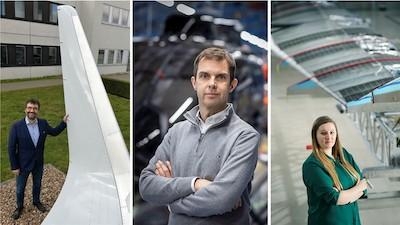
“I like to think that being an engineer involved in aerodynamics gives me a ‘tiny environmental footprint,’” said Dr. Gerd Heller, senior aerodynamics expert with Airbus Commercial Aircraft. “I guided a team that developed the Sharklets on our A320 Family aircraft, and the impact of these wingtip devices on emissions is impressive.”
The Sharklets reduce an A320’s fuel consumption and associated emissions up to 4 percent; applied to a fleet of thousands of aircraft with operational lives of over two decades, Gerd and his team will have helped reduce CO2 emissions in the tens of millions of metric tons.
Another focus is on increasing laminar flow areas over aircraft surfaces – keeping the flow smooth as far downstream as possible. “The better the aerodynamics, the less drag an aircraft produces; and reducing drag cuts emissions from the fuel burned needed to overcome it,” Gerd explained. “Getting the wing shapes right despite the many constraints is exactly what engineers working in aerodynamics love to do!”
At Airbus Helicopters, Luca Cossetti – a research and technology innovative power solutions specialist – agrees that excellent overall design is key to aircraft efficiency and emissions reduction. Cossetti focusses on propulsion, and sees real possibilities in electrification, even with the engineering challenges ahead.
“We’re already getting close to workable hybrid technology that has similarities to the way hybrid cars work,” he explains. Automotive and rotorcraft could use similar methods in how systems manage the timing and blending of thermal and electrical power generation. “We’re planning to optimize the use of thermal and electric power to improve overall safety and efficiency, decreasing environmental impact through fuel consumption and noise.”
Another area involves helicopters and VTOL (vertical take-off and landing) aircraft that would be fully electrically powered. With electric energy storage technology improving, engineers will have the opportunity to prove their value in this area, too. “Once the technologies are ready – including for batteries – the challenges will be to integrate them into an overall aircraft design and to devise or adapt systems which allow safe, efficient, emission-free flight,” says Luca. “This will be one of our day-to-day jobs as engineers: making zero-carbon emission helicopter flight a reality.”
An even more “sustainable” approach is used for Airbus Defence and Space’s Zephyr very high-altitude unmanned aircraft – also known as a pseudo-satellite. Despite its 82-foot wingspan, the lightweight Zephyr can be hand launched by 3-4 people. Once airborne, the pseudo-satellite uses solar power for its climb and operation at an altitude of more than 60,000 ft. “Everything on Zephyr is designed to save weight and reduce drag,” explained Elly Thompson, a payloads system engineer at Airbus.
Zephyr will carry out detailed optical surveillance and deliver new connectivity services from the stratosphere, equipped with a future payload of up to 33 pounds. “Zephyr is able to trace the world’s changing environmental landscape, or provide connectivity to underserved areas,” Thompson said. “Flying for months at a time, it combines the persistence of a satellite with the flexibility of a UAV (unmanned aerial vehicle) and, because it lands at the end of a mission, it can change its payload and take off again.”
Having already achieved a world record for flight endurance in 2018, the Zephyr programme team is confident the next step will involve development of the ecosystem needed to deliver future services from the stratosphere – further proof that Airbus engineers are shaping a sustainable future.
(Image provided with Airbus news release)



 ANN's Daily Aero-Linx (12.12.25)


 See All