
NASA To Air World's First Live 360 Degree Video Of Rocket Launch April 18 | Aero-News Network
Aero-News Network
RSS icon RSS feed
podcast icon MP3 podcast
Subscribe Aero-News e-mail Newsletter Subscribe

Airborne Unlimited -- Most Recent Daily Episodes

Episode Date

Airborne-Monday

Airborne-Tuesday

Airborne-Wednesday Airborne-Thursday

Airborne-Friday

Airborne On YouTube

Airborne-Unlimited-12.01.25

AirborneNextGen-
11.18.25

Airborne-Unlimited-11.19.25

Airborne-AffordableFlyers-11.20.25

AirborneUnlimited-11.21.25

LIVE MOSAIC Town Hall (Archived): www.airborne-live.net

Tue, Apr 18, 2017

NASA To Air World's First Live 360 Degree Video Of Rocket Launch April 18

Launch Of Cygnus Spacecraft To ISS Planned Tuesday

NASA, in coordination with United Launch Alliance (ULA) and Orbital ATK, will broadcast the world's first live 360-degree stream of a rocket launch. The live 360 stream of the cargo resupply mission liftoff to the International Space Station may be viewed on the NASA Television YouTube channel starting 10 minutes prior to lift off.

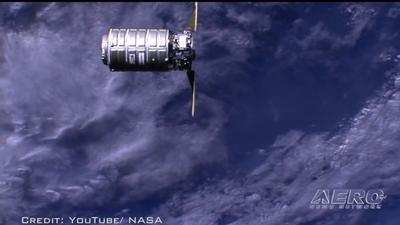
Orbital ATK's Cygnus spacecraft will launch on a ULA Atlas V rocket carrying more than 7,600 pounds of science research, crew supplies and hardware to the orbiting laboratory. Launch is targeted for Tuesday, April 18 during a 30-minute window that opens at 11:11 a.m. EDT.

To view in 360, use a mouse or move a personal device to look up and down, back and forth, for a 360-degree view around Space Launch Complex-41 at Cape Canaveral Air Force Station, Florida. Note: not all browsers support viewing 360 videos. YouTube supports playback of 360-degree videos on computers using Chrome, Firefox, Internet Explorer and Opera browsers. Viewers may use the YouTube app to view the launch on a smart phone. Those who own virtual reality headsets will be able to look around and experience the view as if they were actually standing on the launch pad.

While virtual reality and 360 technology have been increasing in popularity, live 360 technology is a brand new capability that has recently emerged. Recognizing the exciting possibilities opened by applying this new technology to spaceflight, NASA, ULA, and Orbital ATK seized this opportunity to virtually place the public at the base of the rocket during launch. Minimum viewing distance is typically miles away from the launch pad, but the live 360 stream enables viewers to get a pads-eye view.

(Source: NASA news release. Image from file)

FMI: www.nasa.gov/orbitalatk

Advertisement

More News

ANN's Daily Aero-Term (11.29.25): Waypoint

Waypoint A predetermined geographical position used for route/instrument approach definition, progress reports, published VFR routes, visual reporting points or points for transiti>[...]

ANN's Daily Aero-Linx (11.29.25)

Aero Linx: Sentimental Journey to Cub Haven Sentimental Journey Flyin began in 1986 with a group of dedicated volunteers working to provide a sentimental return to Lock Haven, the >[...]

NTSB Prelim: Jabiru USA Sport Aircraft LLC J230-SP

The Pilot Would Often Fly Over Their House At A Low Altitude And That Family Members Would Go Outside To Wave On November 14, 2025, at 1708 eastern standard time, a Jabiru USA Spor>[...]

Classic Aero-TV: Crafting The Future of eVTOL Infrastructure

From 2024 (YouTube Edition): Volatus Infrastructure Paves The Way The name “Volatus” seems to be everywhere these days, popping up in a series of partnerships and proje>[...]

Klyde Morris (11.28.25)

Fortnite Conquers All, Klyde FMI: www.klydemorris.com>[...]

blog comments powered by Disqus



Advertisement

Advertisement

Podcasts

Advertisement

© 2007 - 2025 Web Development & Design by Pauli Systems, LC

