
Navy T-39 Downed Near Blue Ridge, Georgia | Aero-News Network
Aero-News Network
RSS icon RSS feed
podcast icon MP3 podcast
Subscribe Aero-News e-mail Newsletter Subscribe

Airborne Unlimited -- Most Recent Daily Episodes

Episode Date

Airborne-Monday

Airborne-Tuesday

Airborne-Wednesday Airborne-Thursday

Airborne-Friday

Airborne On YouTube

Airborne-Unlimited-12.08.25

AirborneNextGen-
12.09.25

Airborne-Unlimited-12.10.25

Airborne-AffordableFlyers-12.11.25

AirborneUnlimited-12.12.25

AFE 2025 LIVE MOSAIC Town Hall (Archived): www.airborne-live.net

Wed, Apr 14, 2010

Navy T-39 Downed Near Blue Ridge, Georgia

Three Known Dead, One Missing

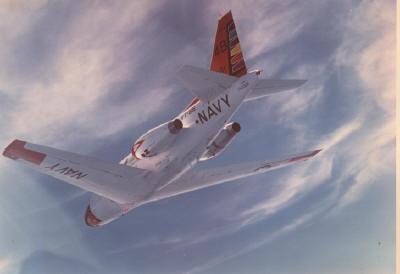
A T-39N Sabreliner went down near Ellijay, Ga., at approximately 1600, April 12th. There were four personnel aboard the aircraft assigned to Training Air Wing Six based out of Naval Air Station Pensacola, Fla.

Rescue crews have recovered three bodies from the crash. The status of the fourth crew member is as yet unknown. The aircraft was conducting a routine cross-country training mission. An investigation board has convened to investigate the cause of the mishap. Names are being withheld pending notification of next of kin.

The T-39 Sabreliner is a multipurpose low-wing, twin-jet aircraft. The 15 T-39Ns — derivatives of the commercial Sabre model 265-40 — are used for training undergraduate military flight officer students in radar navigation and airborne radar-intercept procedures. These aircraft replaced Cessna T-47As during the early 1990s. The eight T-39Gs — derivatives of the commercial Sabre model 265-60 — are used for student non-radar training. These aircraft began replacing Air Force T-1A Jayhawks in Navy training squadrons in mid-1999. It's primary mission is to train Navy and Marine Corps flight officers.

Navy T-39N Specs

Primary Function: Training platform for Navy/Marine Corps flight officers.
Contractor: North American Rockwell.
Propulsion: two Pratt & Whitney J-60-P-3 at 3,000 pounds thrust each.
Length: 44 feet (13.41 meters).
Height: 16 feet (4.88 meters).
Wingspan: 44 feet 6 inches (13.56 meters).
Weight: maximum takeoff, 18,650 pounds (8,460 kg).
Airspeed: 434 knots (499.44 miles per hour; 803.77 km per hour).
Ceiling: 42,000 feet (12,802 meters).
Range: 1,476 nautical miles (1,699 statute miles; 2,734 km).
Crew: Two (7 passengers).
Armament: None.

FMI: www.navy.mil/local/cnatra

Advertisement

More News

ANN's Daily Aero-Linx (12.12.25)

Aero Linx: Commercial Aviation Safety Team (CAST) Founded in 1997, the Commercial Aviation Safety Team (USCAST) has developed an integrated, data-driven strategy to reduce the comm>[...]

ANN's Daily Aero-Term (12.12.25): Land And Hold Short Operations

Land And Hold Short Operations Operations that include simultaneous takeoffs and landings and/or simultaneous landings when a landing aircraft is able and is instructed by the cont>[...]

ANN FAQ: How Do I Become A News Spy?

We're Everywhere... Thanks To You! Even with the vast resources and incredibly far-reaching scope of the Aero-News Network, every now and then a story that should be reported on sl>[...]

NTSB Final Report: Cirrus Design Corp SF50

Pilot’s Inadvertent Use Of The Landing Gear Control Handle Instead Of The Flaps Selector Switch During The Landing Rollout Analysis: The pilot reported that during the landin>[...]

Airborne 12.08.25: Samaritan’s Purse Hijack, FAA Med Relief, China Rocket Fail

Also: Cosmonaut Kicked Out, Airbus Scales Back, AF Silver Star, Russian A-60 Clobbered A Samaritan’s Purse humanitarian flight was hijacked on Tuesday, December 2, while atte>[...]

blog comments powered by Disqus



Advertisement

Advertisement

Podcasts

Advertisement

© 2007 - 2025 Web Development & Design by Pauli Systems, LC

