
Turkish Airlines Acquires Ten Additional A350-900s | Aero-News Network
Aero-News Network
RSS icon RSS feed
podcast icon MP3 podcast
Subscribe Aero-News e-mail Newsletter Subscribe

Airborne Unlimited -- Most Recent Daily Episodes

Episode Date

Airborne-Monday

Airborne-Tuesday

Airborne-Wednesday Airborne-Thursday

Airborne-Friday

Airborne On YouTube

Airborne-Unlimited-12.01.25

AirborneNextGen-
12.02.25

Airborne-Unlimited-12.03.25

Airborne-FltTraining-12.04.25

AirborneUnlimited-12.05.25

AFE 2025 LIVE MOSAIC Town Hall (Archived): www.airborne-live.net

Fri, Sep 08, 2023

Turkish Airlines Acquires Ten Additional A350-900s

Carrier’s A350 Orders Reach Forty Jets

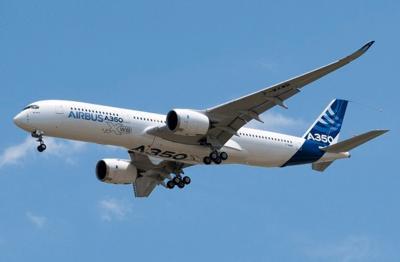
Turkish national flag-carrier Turkish Airlines has announced an order for ten additional A350-900 aircraft, thereby increasing the carrier’s total A350 family orders to forty jets. The agreement supplements the airline’s August 2023 order for four A350-900s. Currently, Turkish Airlines’s fleet comprises 14 A350-900 wide-body aircraft.

Airbus chief commercial officer and head of Airbus International Christian Scherer stated: “We are delighted that Turkish Airlines has decided to further enlarge its fleet with the purchase of ten more A350-900 aircraft. With greater range capability, passenger capacity, and comfort, the A350 is the perfect platform to connect Istanbul to the world. This repeat order demonstrates the confidence for our unique new generation aircraft that offers airlines unbeatable economics and efficiency. We are proud to keep expanding our long-lasting partnership with Turkish Airlines and Turkey’s aviation sector overall.”   

The Airbus A350 is a clean-sheet, long-range, wide-body, twin-engine airliner developed and produced by the consortium in response to Boeing’s successful 787 Dreamliner.  

The A350 is the first Airbus aircraft largely made of carbon-fiber-reinforced polymers. The model’s nine-abreast economy cross-section improves upon the A330/340’s eight-abreast configuration. The A350-900—the type’s first model—accommodates three-hundred to 350 passengers, has a 617,300-pound maximum takeoff weight, and boasts an 8,100-nautical-mile range. Moreover, the A350 shares a common pilot type-rating with its A330 predecessor. The machine is powered by a pair of 84,200-lbf. Rolls-Royce Trent XWB high-bypass turbofan engines which motivate it to a maximum cruise speed of 0.89 Mach (513-knots) and a service-ceiling of FL430. Normal cruise speed is to the order of 0.85 Mach (488-knots).

The A350 prototype first flew on 14 June 2013 from Toulouse, France. Type certification was granted by the European Aviation Safety Agency (EASA) in September 2014; Federal Aviation Administration (FAA) type certification was granted two months later. The A350 entered service with launch-customer Qatar Airways on 24 February 2018.

To date, global air-carriers have booked over one-thousand A350 orders.

FMI: www.airbus.com
 

Advertisement

More News

Aero-FAQ: Dave Juwel's Aviation Marketing Stories -- ITBOA BNITBOB

Dave Juwel's Aviation Marketing Stories ITBOA BNITBOB ... what does that mean? It's not gibberish, it's a lengthy acronym for "In The Business Of Aviation ... But Not In The Busine>[...]

NTSB Prelim: Rutan Long-EZ

The Pilot Attempted Several Times To Restart The Engine And Diverted To Long Beach Airport/Daughtery Field On October 20, 2025, about 1603 Pacific daylight time, an experimental am>[...]

ANN's Daily Aero-Term (12.05.25): Hazardous Weather Information

Hazardous Weather Information Summary of significant meteorological information (SIGMET/WS), convective significant meteorological information (convective SIGMET/WST), urgent pilot>[...]

Aero-News: Quote of the Day (12.05.25)

"The latest development underscores the government of Malaysia’s commitment in providing closure to the families affected by this tragedy..." Source: From statements made by >[...]

Airborne-Flight Training 12.04.25: Ldg Fee Danger, Av Mental Health, PC-7 MKX

Also: IAE Acquires Diamond Trainers, Army Drones, FedEx Pilots Warning, DA62 MPP To Dresden Tech Uni The danger to the flight training industry and our future pilots is clear. Dona>[...]

blog comments powered by Disqus



Advertisement

Advertisement

Podcasts

Advertisement

© 2007 - 2025 Web Development & Design by Pauli Systems, LC

