
Boeing Unveils Deep Space Concepts For Moon and Mars Exploration | Aero-News Network
Aero-News Network
RSS icon RSS feed
podcast icon MP3 podcast
Subscribe Aero-News e-mail Newsletter Subscribe

Airborne Unlimited -- Most Recent Daily Episodes

Episode Date

Airborne-Monday

Airborne-Tuesday

Airborne-Wednesday Airborne-Thursday

Airborne-Friday

Airborne On YouTube

Airborne-Unlimited-12.08.25

AirborneNextGen-
12.09.25

Airborne-Unlimited-12.10.25

Airborne-FltTraining-12.04.25

AirborneUnlimited-12.05.25

AFE 2025 LIVE MOSAIC Town Hall (Archived): www.airborne-live.net

Mon, Apr 10, 2017

Boeing Unveils Deep Space Concepts For Moon and Mars Exploration

Deep Space Gateway, Transport Critical To Future Human Space Activities

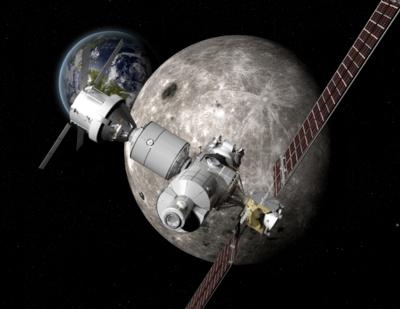
Boeing has unveiled concepts for the deep space gateway and transport systems that could help achieve NASA’s goal of having robust human space exploration from the Moon to Mars.

NASA’s Space Launch System, which Boeing is helping develop, would deliver the habitat to cislunar space near the Moon. Known as the Deep Space Gateway, the habitat could support critical research and help open opportunities for global government or commercial partnerships in deep space, including lunar missions. It would be powered by a Solar Electric Propulsion (SEP) system.

“The ability to simultaneously launch humans and cargo on SLS would allow us to assemble the gateway in four launches in the early 2020s,” said Pete McGrath, director of global sales and marketing for Boeing’s space exploration division.

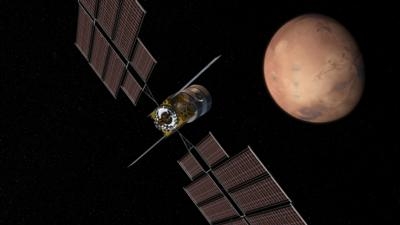
The Deep Space Gateway could be the waypoint for Mars missions. Utilizing a docking system akin to what the International Space Station uses for commercial operations, it could host the Deep Space Transport vehicle, which would take humans to Mars. Once near Mars, crews could deploy a lander for surface missions or conduct other scientific and robotic missions in orbit.

The transport vehicle would be equipped with a habitat specifically designed to protect passengers from deep space’s harsh environment and its own robust SEP bus.

In fact, both of Boeing’s concepts leverage proven solar electric propulsion technology and hardware design from the 702 satellite family.

The gateway and transport systems are partially being developed as part of NASA’s Next Space Technologies for Exploration Technologies (Next Step) program and an ongoing High Power SEP technology development effort within the NASA Space Technology Mission Directorate (STMD).

(Images provided with Boeing news release)

FMI: www.boeing.comx

Advertisement

More News

ANN's Daily Aero-Term (12.08.25): Decision Altitude (DA)

Decision Altitude (DA) A specified altitude (mean sea level (MSL)) on an instrument approach procedure (ILS, GLS, vertically guided RNAV) at which the pilot must decide whether to >[...]

ANN's Daily Aero-Linx (12.08.25)

Aero Linx: T-34 Association, Inc. The T-34 Association was formed in July 1975 so that individuals purchasing then military surplus T-34As had an organization which would provide s>[...]

NTSB Final Report: Piper PA-31T3

As He Released The Brakes To Begin Taxiing, The Brake Pedals Went To The Floor With No Braking Action Analysis: The pilot reported that during engine start up, he applied the brake>[...]

Aero-News: Quote of the Day (12.08.25)

“Legislation like the Mental Health in Aviation Act is still imperative to hold the FAA accountable for the changes they clearly acknowledge need to be made... We cannot wait>[...]

Airborne-Flight Training 12.04.25: Ldg Fee Danger, Av Mental Health, PC-7 MKX

Also: IAE Acquires Diamond Trainers, Army Drones, FedEx Pilots Warning, DA62 MPP To Dresden Tech Uni The danger to the flight training industry and our future pilots is clear. Dona>[...]

blog comments powered by Disqus



Advertisement

Advertisement

Podcasts

Advertisement

© 2007 - 2025 Web Development & Design by Pauli Systems, LC

