
NTSB: Geese Cooked Engines On US Airways 1549 | Aero-News Network
Aero-News Network
RSS icon RSS feed
podcast icon MP3 podcast
Subscribe Aero-News e-mail Newsletter Subscribe

Airborne Unlimited -- Most Recent Daily Episodes

Episode Date

Airborne-Monday

Airborne-Tuesday

Airborne-Wednesday Airborne-Thursday

Airborne-Friday

Airborne On YouTube

Airborne-Unlimited-12.08.25

AirborneNextGen-
12.09.25

Airborne-Unlimited-12.10.25

Airborne-AffordableFlyers-12.11.25

AirborneUnlimited-12.12.25

AFE 2025 LIVE MOSAIC Town Hall (Archived): www.airborne-live.net

Fri, Feb 13, 2009

NTSB: Geese Cooked Engines On US Airways 1549

Adult Birds Often Exceed Engine Ingestion Weight Standard

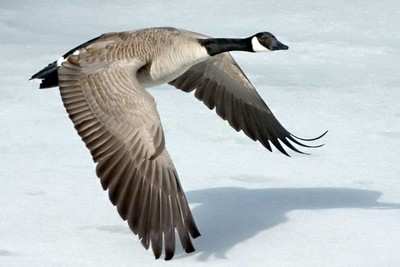
The National Transportation Safety Board confirmed Thursday the bird remains found in both engines of US Airways flight 1549 have been identified by the Smithsonian Institution's Feather Identification Laboratory as Canada Goose (Branta canadensis).

The lab made the identification for the NTSB through DNA analysis as well as through morphological comparisons in which feather fragments were compared with Canada Goose specimens in the museum's collections; the microscopic feather samples were compared with reference microslide collections.

A total of 25 samples of bird remains have been examined as of Thursday. Additional analysis will be conducted on samples received from the NTSB to attempt to determine if the Canada Geese were resident or migratory.

While no determination has been made about how many birds the aircraft struck or how many were ingested into the engines, an adult Canada Goose typically ranges in size from 5.8 to 10.7 pounds, though larger individual resident birds can exceed published records.

The accident aircraft was powered by two CFM56-5B/P turbofan engines. The bird ingestion standard in effect when this engine type was certified in 1996 included the requirement that the engine must withstand the ingestion of a four-pound bird without catching fire, without releasing hazardous fragments through the engine case, without generating loads high enough to potentially compromise aircraft structural components, or without losing the capability of being shut down. The certification standard does not require that the engine be able to continue to generate thrust after ingesting a bird four pounds or larger.

NTSB investigators worked closely with wildlife biologists from the United States Department of Agriculture, both at the scene of the accident in New York City and during the engine teardowns at the manufacturer's facility in Cincinnati, to extract all of the organic material that was identified.

(Goose photo by Chuck Szmurlo)

FMI: www.ntsb.gov, www.usairways.com

Advertisement

More News

ANN FAQ: Contributing To Aero-TV

How To Get A Story On Aero-TV News/Feature Programming How do I submit a story idea or lead to Aero-TV? If you would like to submit a story idea or lead, please contact Jim Campbel>[...]

Aero-News: Quote of the Day (12.10.25)

“As the excitement builds for the world of flight returning to Oshkosh in 2026, we wanted to ensure that advance tickets are available for those who enjoy giving AirVenture t>[...]

ANN's Daily Aero-Term (12.10.25): North Atlantic High Level Airspace (NAT HLA)

North Atlantic High Level Airspace (NAT HLA) That volume of airspace (as defined in ICAO Document 7030) between FL 285 and FL 420 within the Oceanic Control Areas of Bodo Oceanic, >[...]

Airborne 12.08.25: Samaritan’s Purse Hijack, FAA Med Relief, China Rocket Fail

Also: Cosmonaut Kicked Out, Airbus Scales Back, AF Silver Star, Russian A-60 Clobbered A Samaritan’s Purse humanitarian flight was hijacked on Tuesday, December 2, while atte>[...]

Airborne-Flight Training 12.04.25: Ldg Fee Danger, Av Mental Health, PC-7 MKX

Also: IAE Acquires Diamond Trainers, Army Drones, FedEx Pilots Warning, DA62 MPP To Dresden Tech Uni The danger to the flight training industry and our future pilots is clear. Dona>[...]

blog comments powered by Disqus



Advertisement

Advertisement

Podcasts

Advertisement

© 2007 - 2025 Web Development & Design by Pauli Systems, LC

