Wed, Aug 10, 2005
Controllers' Union Says Dulles Would See Capacity Cut By At
Least 30-Percent
Just days after the head of the Federal Aviation Administration
told reporters that bad weather, crowded flights and a lack of
pavement at critical airports caused record delays in July, the
agency has announced it will implement a new restriction that will
greatly exacerbate flight delays. The restriction will end the
practice of allowing aircraft to hold on the runway, awaiting
takeoff clearance and, in the process, the FAA is unnecessarily
forcing its tower personnel to scramble to meet a September 30
deadline to show why their tower should continue using the
longstanding practice that maximizes runway efficiency.
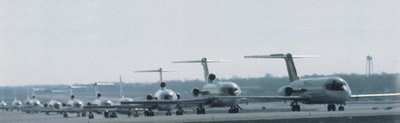
The practice, known as taxi into position and hold (TIPH),
enables controllers to safely and efficiently move aircraft by
instructing pilots to assume takeoff position on the runway. The
restriction will force aircraft to wait unnecessarily on the
taxiway and the result will be a backup of planes and a dramatic
decrease in airport capacity.
Rather than examine the specifics at each airport to see if
changes are needed, the FAA will suspend the practice at all
airports unless the tower manager can demonstrate that it is
needed. Air traffic controllers are deeply concerned about both the
adverse effect it will have on efficiency and the wasteful
expenditure of resources by the FAA to force facilities into
compliance or to seek waivers.
"These towers now have to jump through hoops to do on October
1st what they've done quite successfully for the last 50-plus
years," National Air Traffic Controllers Association President John
Carr said. "While the FAA asserts this is to improve runway safety,
the likely outcome is that busy airports will eventually get
waivers, leaving the real safety concerns unaddressed, while other
airports will operate under unnecessary restrictions. Pilots will
have no effective way of knowing where this rule is in effect and
where it has been waived, and the FAA will have expended untold
resources to create the appearance of safety management without
doing anything that actually enhances the safety of the
system."
Ending TIPH at busy airports is likely to have severe
consequences, according to Carr. At Washington Dulles, capacity
would fall by at least 30 percent, resulting in major delays. At
Oakland, CA, more than 50-percent of departures would experience
delays.
More News
Decision Altitude (DA) A specified altitude (mean sea level (MSL)) on an instrument approach procedure (ILS, GLS, vertically guided RNAV) at which the pilot must decide whether to >[...]
Aero Linx: T-34 Association, Inc. The T-34 Association was formed in July 1975 so that individuals purchasing then military surplus T-34As had an organization which would provide s>[...]
As He Released The Brakes To Begin Taxiing, The Brake Pedals Went To The Floor With No Braking Action Analysis: The pilot reported that during engine start up, he applied the brake>[...]
“Legislation like the Mental Health in Aviation Act is still imperative to hold the FAA accountable for the changes they clearly acknowledge need to be made... We cannot wait>[...]
Also: IAE Acquires Diamond Trainers, Army Drones, FedEx Pilots Warning, DA62 MPP To Dresden Tech Uni The danger to the flight training industry and our future pilots is clear. Dona>[...]



 ANN's Daily Aero-Term (12.08.25): Decision Altitude (DA)


 See All