

GPS Improves Safety In Older Military Helos | Aero-News Network
Aero-News Network
RSS icon RSS feed
podcast icon MP3 podcast
Subscribe Aero-News e-mail Newsletter Subscribe

Airborne Unlimited -- Most Recent Daily Episodes

Episode Date

Airborne-Monday

Airborne-Tuesday

Airborne-Wednesday Airborne-Thursday

Airborne-Friday

Airborne On YouTube

Airborne-Unlimited-12.01.25

AirborneNextGen-
12.02.25

Airborne-Unlimited-12.03.25

Airborne-AffordableFlyers-11.20.25

AirborneUnlimited-11.21.25

LIVE MOSAIC Town Hall (Archived): www.airborne-live.net

Fri, Dec 04, 2009

GPS Improves Safety In Older Military Helos

Synthetic Vision Helps Prevent Controlled Flight Into Terrain

GPS technology is being applied to older rotary-wing aircraft to help save lives, a senior helicopter pilot based at Andrews Air Force Base, Maryland, said this week.

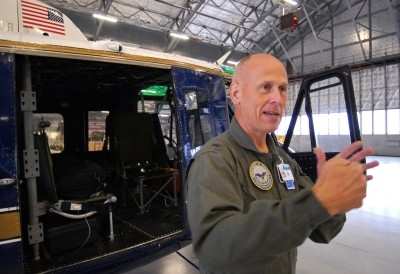
Air Force Col. Peter Mapes and other pilots at Andrews will install and test advanced GPS units, designed originally for airplanes, in some of the 316th Wing, 1st Helicopter Squadron's UH-1N "Huey" helicopters. "This is game-changing technology because it directly addresses the leading cause of loss of life in this type of aeronautical vehicle," Mapes said.

The Defense Safety Oversight Council sponsored the test as part of efforts to reduce helicopter mishaps. From 1985 to 2005, 917 non-combat mishaps occurred, resulting in death, injury, damage exceeding $200,000, and the loss of aircraft. Most helicopter fatalities are caused by impact with terrain - unseen mountains, trees or other obstructions -- known as controlled flight into terrain or CFIT. Because the vehicles are generally moving at high speed during such collisions, more than 90 percent of passengers and crew exposed to these events are injured or killed.

The GPS units installed in the Hueys help prevent those accidents by displaying maps of potential obstructions at a certain elevation. "This device has a global terrain database and will warn you of any potential collision," Mapes said. "It also has an obstruction database for North America, Central America and Western Europe that will warn about towers if you're in those areas." The new GPS systems, he explained, turn each helicopter into a sort of "mini radar station." In addition to providing data on obstructions and terrain, it also tracks weather patterns - including lightning strikes, wind flow and rain - and other aircraft in the area.

Colonel Peter Mapes

Unexpectedly bad weather is the second leading non-human factor responsible for Army helicopter mishaps, and the leading non-human factor causing fatalities. But, by using the new equipment, officials say, a pilot can essentially fly "blind" using the GPS and weather data to make flight plans, observe potential obstructions and even land the aircraft with minimal visibility.

The unit, a GNS-530AWT produced by Garmin, also gives the helicopters radio communication and navigation requirements, making them easy to deploy worldwide.

FMI: www.af.mil

Advertisement

More News

ANN's Daily Aero-Term (12.01.25): Convective SIGMET

Convective SIGMET A weather advisory concerning convective weather significant to the safety of all aircraft. Convective SIGMETs are issued for tornadoes, lines of thunderstorms, e>[...]

ANN's Daily Aero-Linx (12.01.25)

Aero Linx: United Flying Octogenarians WELCOME to a most extraordinary group of aviators, the United Flying Octogenarians (UFO). Founded in 1982 with just a handful of pilots, we h>[...]

NTSB Final Report: Remos Aircraft GmbH Remos GX

Pilot’s Decision To Attempt Takeoff With Frost Covering The Airplane’s Wings Analysis: The pilot of the light sport airplane was preparing to depart for a cross-country>[...]

Aero-News: Quote of the Day (12.02.25)

“We’ve paid for the cable line’s repair for the customer and have apologized for the inconvenience this caused them...” Source: Some followup info from an A>[...]

ANN's Daily Aero-Term (12.02.25): Coupled Approach

Coupled Approach An instrument approach performed by the aircraft autopilot, and/or visually depicted on the flight director, which is receiving position information and/or steerin>[...]

blog comments powered by Disqus



Advertisement

Advertisement

Podcasts

Advertisement

© 2007 - 2025 Web Development & Design by Pauli Systems, LC

