Planet Is Not Habitable, But Still Considered A Significant Find
NASA's Spitzer Space Telescope has detected light emanating from a "super-Earth" planet beyond our solar system for the first time. While the planet is not habitable, the detection is a historic step toward the eventual search for signs of life on other planets. "Spitzer has amazed us yet again," said Bill Danchi, Spitzer program scientist at NASA Headquarters in Washington. "The spacecraft is pioneering the study of atmospheres of distant planets and paving the way for NASA's upcoming James Webb Space Telescope to apply a similar technique on potentially habitable planets."
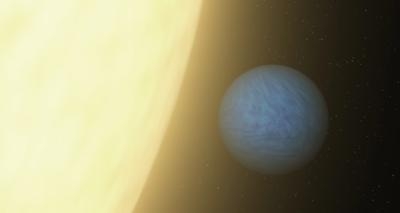
The planet, called 55 Cancri e, falls into a class of planets termed super Earths, which are more massive than our home world but lighter than giant planets like Neptune. Fifty-five Cancri e is about twice as big and eight times as massive as Earth. The planet orbits a bright star, called 55 Cancri, in a mere 18 hours. Previously, Spitzer and other telescopes were able to study the planet by analyzing how the light from 55 Cancri changed as the planet passed in front of the star. In the new study, Spitzer measured how much infrared light comes from the planet itself. The results reveal the planet is likely dark and its sun-facing side is more than 2,000 Kelvin (3,140 degrees Fahrenheit), hot enough to melt metal.
The new information is consistent with a prior theory that 55 Cancri e is a water world: a rocky core surrounded by a layer of water in a "supercritical" state where it is both liquid and gas, and topped by a blanket of steam. "It could be very similar to Neptune, if you pulled Neptune in toward our sun and watched its atmosphere boil away," said Michaël Gillon of Universite de Liege in Belgium, principal investigator of the research, which appears in the Astrophysical Journal. The lead author is Brice-Olivier Demory of the Massachusetts Institute of Technology in Cambridge.
The 55 Cancri system is relatively close to Earth at 41 light-years away. It has five planets, with 55 Cancri e being the closest to the star and tidally locked, so one side always faces the star. Spitzer discovered the sun-facing side is extremely hot, indicating the planet probably does not have a substantial atmosphere to carry the sun's heat to the unlit side.
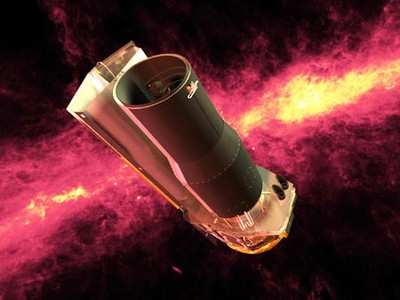
NASA's James Webb Space Telescope, scheduled to launch in 2018, likely will be able to learn even more about the planet's composition. The telescope might be able to use a similar infrared method as Spitzer to search other potentially habitable planets for signs of molecules possibly related to life. "When we conceived of Spitzer more than 40 years ago, exoplanets hadn't even been discovered," said Michael Werner, Spitzer project scientist at NASA's Jet Propulsion Laboratory (JPL) in Pasadena, Calif. "Because Spitzer was built very well, it's been able to adapt to this new field and make historic advances such as this."
In 2005, Spitzer became the first telescope to detect light from a planet beyond our solar system. To the surprise of many, the observatory saw the infrared light of a "hot Jupiter," a gaseous planet much larger than the solid 55 Cancri e. Since then, other telescopes, including NASA's Hubble and Kepler space telescopes, have performed similar feats with gas giants using the same method. In this method, a telescope gazes at a star as a planet circles behind it. When the planet disappears from view, the light from the star system dips ever so slightly, but enough that astronomers can determine how much light came from the planet itself. This information reveals the temperature of a planet, and, in some cases, its atmospheric components. Most other current planet-hunting methods obtain indirect measurements of a planet by observing its effects on the star.
During Spitzer's ongoing extended mission, steps were taken to enhance its unique ability to see exoplanets, including 55 Cancri e. Those steps, which included changing the cycling of a heater and using an instrument in a new way, led to improvements in how precisely the telescope points at targets. (Images provided by NASA)



 ANN's Daily Aero-Term (12.08.25): Decision Altitude (DA)


 See All