Systems Able To Track Damage On Rotating Helo Parts
 MicroStrain, Inc. announced
Tuesday it performed a successful flight test of next generation
wireless strain sensors for damage tracking of rotating helicopter
parts and other dynamic components. The flight test coincided with
the release of the company's energy harvesting wireless strain
sensing modules into the market.
MicroStrain, Inc. announced
Tuesday it performed a successful flight test of next generation
wireless strain sensors for damage tracking of rotating helicopter
parts and other dynamic components. The flight test coincided with
the release of the company's energy harvesting wireless strain
sensing modules into the market.
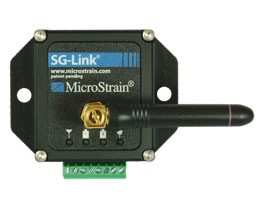
The miniaturized energy harvesting sensing nodes, called
ESG-LINK, have a precision time keeper, non-volatile memory for
on-board data logging, and a frequency agile transceiver. Sampling
rates, sample durations, sensor offsets, sensor gains and on-board
shunt calibration are all wirelessly programmable.
According to the Vermont-based company, these sensing systems
will operate indefinitely -- without the need for batteries, by
converting the component's cyclic strains into DC power using
piezoelectric materials.
Piezoelectric materials is defined by the Heritage Dictionary
as: "The generation of electricity or of electric polarity in
dielectric crystals subjected to mechanical stress, or the
generation of stress in such crystals subjected to an applied
voltage."
Recent flight tests on a Bell 412 has shown the nodes will,
indeed, operate continually, without batteries, even under low
energy generation conditions of straight and level helicopter
flight. By continuously monitoring the strains on rotating
components, the nodes can record operational loads, compute metal
fatigue, and estimate remaining component life.
The critical component instrumented on the Bell M412 was the
pitch link. The pitch link's controls the rotor blade's angle of
attack during rotation. Pitch link loads vary strongly with
aircraft flight regimes, reaching much higher loads, as much as six
times, during pull ups and gunnery turns as compared to straight
and level flight. Therefore the pitch link is an excellent
indicator of vehicle usage severity, and can provide critical data
for improved condition based maintenance.
Strain gauges bonded to the pitch link were arranged to cancel
thermal and bending effects and to amplify tension/compression
loads. Bench calibrations allowed the strain gauge bridge to
provide load data during flight. While spinning at five revolutions
per second, data were logged within the wireless node's
non-volatile memory and also periodically transmitted to a small
mobile base station located in the helicopter's cabin. Flight test
data from MicroStrain's wireless nodes were compared to data
collected by from hard wired strain gauges, using slip rings, with
close agreement.
 Reducing power consumption is
a key requirement when energy harvesting, because the energy
"checkbook" must be balanced to support continuous operation. The
company's engineers have recently reported on smart wireless sensor
nodes that adapt their operating modes in accordance with the
amount of energy available.
Reducing power consumption is
a key requirement when energy harvesting, because the energy
"checkbook" must be balanced to support continuous operation. The
company's engineers have recently reported on smart wireless sensor
nodes that adapt their operating modes in accordance with the
amount of energy available.
The latest adaptive energy harvesting wireless sensors can
sample pitch link static and dynamic loads at a rate of 32 samples
per second, then communicate these wireless data into the
helicopter cabin, while consuming only 250 microwatts; compared to
conventional Wheatstone bridge signal conditioning electronics,
which draw 72 milliwatts.
"We're delighted to release our energy harvesting wireless
sensing technology at Sensors Expo 2007. Our first successful
flight test, performed in concert with Bell Helicopter, has
demonstrated that our technology works. The potential of energy
harvesting combined with wireless sensing will now begin to be
fully realized, not only on rotating helicopter components, but on
a wide range of machines, structures, and systems", said
MicroStrain president Steven Arms.



 ANN FAQ: Contributing To Aero-TV


 See All