
Galileo Satellites Set To Fly On Ariane 6 | Aero-News Network
Aero-News Network
RSS icon RSS feed
podcast icon MP3 podcast
Subscribe Aero-News e-mail Newsletter Subscribe

Airborne Unlimited -- Most Recent Daily Episodes

Episode Date

Airborne-Monday

Airborne-Tuesday

Airborne-Wednesday Airborne-Thursday

Airborne-Friday

Airborne On YouTube

Airborne-SpecialEpisode-12.15.25

AirborneNextGen-
12.16.25

Airborne-Unlimited-12.10.25

Airborne-AffordableFlyers-12.11.25

AirborneUnlimited-12.12.25

AFE 2025 LIVE MOSAIC Town Hall (Archived): www.airborne-live.net

Thu, Sep 21, 2017

Galileo Satellites Set To Fly On Ariane 6

Four New Spacecraft Scheduled For Launch Beginning In 2020

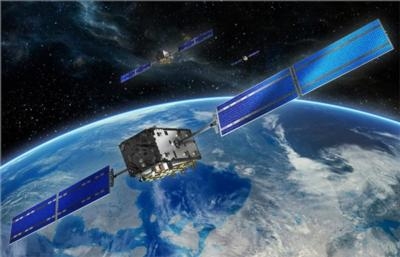
Four of the latest set of Galileo navigation satellites will be launched on Ariane 6 rockets – ESA’s first contract to use Europe’s new vehicle. The launches are scheduled between the end of 2020 and mid-2021, using two Ariane 6 rockets – the configuration of Europe’s next-generation launch vehicle that is best suited to haul the two navigation satellites into their orbits at 23,222 km (approx 14,500 miles) in altitude.

Under development, Ariane 6 is Europe’s newest launcher, designed to extend guaranteed access to space for Europe at a competitive price. It will operate in two configurations, depending on customer needs: Ariane 62 is fitted with two strap-on boosters while Ariane 64 has four. “Ariane 6 is not only in full development, but it will soon be put to use,” notes Daniel Neuenschwander, ESA’s Director of Space Transportation. “This contract is a key step in the upcoming ramp-up phase of Ariane 6.”

The Galileos have so far either been launched in pairs by Soyuz from French Guiana or in fours by Ariane 5.

A new Ariane 5 flight is scheduled for the end of this year, to add four more satellites to the 18-strong constellation already in orbit. This month saw the arrival of the first elements of the rocket in French Guiana, transported aboard the MN Colibri roll-on/roll-off ship.

The contract specifies the decision to use Ariane 62 is subject to the vehicle’s development schedule, with Soyuz available as an alternative. A final choice will be made at the end of 2018, two years before the first launch.

Galileo is Europe’s own satellite navigation system, providing an array of positioning, navigation and timing services to Europe and the world. A further eight Galileo ‘Batch 3’ satellites were ordered last June, to supplement the 26 built so far.

With 18 satellites now in orbit, Galileo began initial services on 15 December 2016, the first step towards full operations.

Further launches will continue to build the constellation, which will gradually improve system performance and availability worldwide.

The launch contract with Arianespace was signed by Paul Verhoef, ESA’s Director of the Galileo Program and Navigation-related Activities, and Stéphane Israel, Arianespace’s Chief Executive Officer. ESA signed the contract on behalf of the EU represented by the European Commission – Galileo’s owner. The Commission and ESA have a delegation agreement by which ESA acts as design and procurement agent on behalf of the Commission.

(Image provided with Arianespace news release)

FMI: www.arianespace.com

Advertisement

More News

Aero-News: Quote of the Day (12.18.25)

“These new aircraft strengthen our ability to respond quickly, train effectively and support communities nationwide. Textron Aviation has been a steadfast supporter in helpin>[...]

Classic Aero-TV: Viking Twin Otter 400--Bringing the DHC-6 Back Into Production

From 2011 (YouTube Edition): Rugged, Legendary, STOL Twin Makes A Comeback The de Havilland Twin Otter is an airplane with a long history, and it gained a reputation as a workhorse>[...]

NTSB Final Report: Rans Employee Flying Club Rans S-6ES Coyote II

A Wind Gust Lifted The Right Wing And The Airplane Turned To The Left Analysis: The pilot was departing from a 2,395-ft-long by 50-ft-wide turf runway. The pilot reported that afte>[...]

ANN FAQ: Submit a News Story!

Have A Story That NEEDS To Be Featured On Aero-News? Here’s How To Submit A Story To Our Team Some of the greatest new stories ANN has ever covered have been submitted by our>[...]

ANN's Daily Aero-Term (12.18.25): Braking Action Advisories

Braking Action Advisories When tower controllers receive runway braking action reports which include the terms “medium," “poor," or “nil," or whenever weather con>[...]

blog comments powered by Disqus



Advertisement

Advertisement

Podcasts

Advertisement

© 2007 - 2025 Web Development & Design by Pauli Systems, LC

