
NASA's Phoenix Lander Confirms Martian Water | Aero-News Network
Aero-News Network
RSS icon RSS feed
podcast icon MP3 podcast
Subscribe Aero-News e-mail Newsletter Subscribe

Airborne Unlimited -- Most Recent Daily Episodes

Episode Date

Airborne-Monday

Airborne-Tuesday

Airborne-Wednesday Airborne-Thursday

Airborne-Friday

Airborne On YouTube

Airborne-Unlimited-11.24.25

AirborneNextGen-
11.18.25

Airborne-Unlimited-11.19.25

Airborne-AffordableFlyers-11.20.25

AirborneUnlimited-11.21.25

LIVE MOSAIC Town Hall (Archived): www.airborne-live.net

Fri, Aug 01, 2008

NASA's Phoenix Lander Confirms Martian Water

Agency Expands Spacecraft's Mission

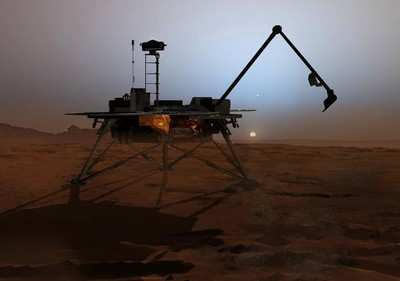
NASA announced Thursday that laboratory tests aboard its Phoenix Mars Lander have identified water in a soil sample. The lander's robotic arm delivered the sample Wednesday to an instrument that identifies vapors produced by the heating of samples.

"We have water," said William Boynton of the University of Arizona, lead scientist for the Thermal and Evolved-Gas Analyzer, or TEGA. "We've seen evidence for this water ice before in observations by the Mars Odyssey orbiter and in disappearing chunks observed by Phoenix last month, but this is the first time Martian water has been touched and tasted."

With enticing results so far and the spacecraft in good shape, NASA also announced operational funding for the mission will extend through Sept. 30. The original prime mission of three months ends in late August. The mission extension adds five weeks to the 90 days of the prime mission.

"Phoenix is healthy and the projections for solar power look good, so we want to take full advantage of having this resource in one of the most interesting locations on Mars," said Michael Meyer, chief scientist for the Mars Exploration Program at NASA Headquarters in Washington.

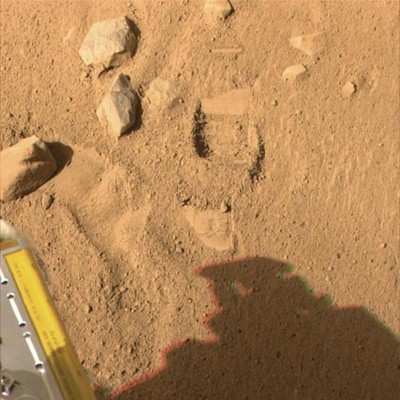
The soil sample came from a trench approximately two inches deep. When the robotic arm first reached that depth, it hit a hard layer of frozen soil. Two attempts to deliver samples of

icy soil on days when fresh material was exposed were foiled when the samples became stuck inside the scoop. Most of the material in Wednesday's sample had been exposed to the air for two days, letting some of the water in the sample vaporize away and making the soil easier to handle.

"Mars is giving us some surprises," said Phoenix principal investigator Peter Smith of the University of Arizona. "We're excited because surprises are where discoveries come from. One surprise is how the soil is behaving. The ice-rich layers stick to the scoop when poised in the sun above the deck, different from what we expected from all the Mars simulation testing we've done. That has presented challenges for delivering samples, but we're finding ways to work with it and we're gathering lots of information to help us understand this soil."

Since landing on May 25, Phoenix has been studying soil with a chemistry lab, TEGA, a microscope, a conductivity probe and cameras. Besides confirming the 2002 finding from orbit of water ice near the surface and deciphering the newly observed stickiness, the science team is trying to determine whether the water ice ever thaws enough to be available for biology and if carbon-containing chemicals and other raw materials for life are present.

The mission is examining the sky as well as the ground. A Canadian instrument is using a laser beam to study dust and clouds overhead.

"It's a 30-watt light bulb giving us a laser show on Mars," said Victoria Hipkin of the Canadian Space Agency.

A full-circle, color panorama of Phoenix's surroundings also has been completed by the spacecraft.

"The details and patterns we see in the ground show an ice-dominated terrain as far as the eye can see," said Mark Lemmon of Texas A&M University, lead scientist for Phoenix's Surface Stereo Imager camera. "They help us plan measurements we're making within reach of the robotic arm and interpret those measurements on a wider scale."

FMI: www.nasa.gov/phoenix

Advertisement

More News

ANN's Daily Aero-Term (11.28.25): Unmanned Aircraft System (UAS)

Unmanned Aircraft System (UAS) An unmanned aircraft and its associated elements related to safe operations, which may include control stations (ground, ship, or air based), control>[...]

ANN's Daily Aero-Linx (11.28.25)

Aero Linx: Cactus Fly-In The Classic Airplane Association of Arizona, Inc. (CAAA) was incorporated in Arizona as a not for profit corporation on January 10, 2014. The CAAA roster i>[...]

Airborne 11.21.25: NTSB on UPS Accident, Shutdown Protections, Enstrom Update

Also: UFC Buys Tecnams, Emirates B777-9 Buy, Allegiant Pickets, F-22 And MQ-20 The NTSB's preliminary report on the UPS Flight 2976 crash has focused on the left engine pylon's sep>[...]

Airborne 11.26.25: Bonanza-Baron Fini, Archer v LA NIMBYs, Gogo Loses$$$

Also: Bell 505 on SAF, NYPA Gets Flak For BizAv 'Abuse', FAA Venezuela Caution, Horizon Update Textron Aviation has confirmed it will be ending production of the Beechcraft Bonanza>[...]

Airborne-NextGen 11.25.25: EHang Manned Flt, Army UAVs, Starship V3 Booster Boom

Also: FedEx SAF, Archer Midnight Powertrain Tech, Rocket Lab Record, Perseverance Rover Find EHang has logged a major milestone in the development of its pilotless air taxi, loggin>[...]

blog comments powered by Disqus



Advertisement

Advertisement

Podcasts

Advertisement

© 2007 - 2025 Web Development & Design by Pauli Systems, LC

