
Space Plumbers! ISS Astros Have A Full List Of Chores... | Aero-News Network
Aero-News Network
RSS icon RSS feed
podcast icon MP3 podcast
Subscribe Aero-News e-mail Newsletter Subscribe

Airborne Unlimited -- Most Recent Daily Episodes

Episode Date

Airborne-Monday

Airborne-Tuesday

Airborne-Wednesday Airborne-Thursday

Airborne-Friday

Airborne On YouTube

Airborne-Unlimited-12.01.25

AirborneNextGen-
12.02.25

Airborne-Unlimited-12.03.25

Airborne-AffordableFlyers-11.20.25

AirborneUnlimited-11.21.25

LIVE MOSAIC Town Hall (Archived): www.airborne-live.net

Fri, Sep 04, 2020

Space Plumbers! ISS Astros Have A Full List Of Chores...

Heart Studies, AC and Plumbing Work Fill Orbital Schedule

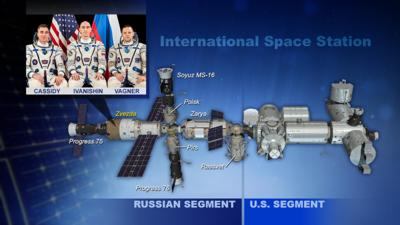
The three-person Expedition 63 crew focused its attention recently on Japanese science hardware and Russian cardiac studies. The International Space Station trio also serviced air conditioning and plumbing systems.

The Kibo laboratory module from JAXA (Japan Aerospace Exploration Agency) enables a multitude of space science taking place both inside and outside the orbital lab. Kibo has an airlock that the crew can place external experiments and even satellites for deployment into the vacuum of space.

Commander Chris Cassidy spent the first part of Thursday removing a commercial science payload from Kibo’s airlock. The NanoRacks External Platform supports a variety of research requiring exposure to the space environment. The automated science experiments look at different technologies and phenomena including robotics, physics, and microbiology that can benefit Earth and space industries.

Cassidy switched roles in the afternoon from space scientist to orbital maintenance man. The veteran NASA astronaut checked out spacecraft atmosphere monitor components and updated software supporting the Waste and Hygiene Compartment, the station’s restroom.

Roscosmos cosmonauts Anatoly Ivanishin and Ivan Vagner continued a second day of heart research to understand how the human body adapts to long-term weightlessness. The duo explored the benefits of a negative pressure lower body suit that prevents blood and body fluids from pooling toward an astronaut’s head, a unique space condition commonly known as “puffy face.”

Ivanishin also replaced battery components before setting up advanced Earth photography gear. Vagner worked on fluid transfers throughout the station’s Russian segment then moved on and updated lab inventory files.

FMI: www.nasa.gov

Advertisement

More News

ANN's Daily Aero-Term (12.01.25): Convective SIGMET

Convective SIGMET A weather advisory concerning convective weather significant to the safety of all aircraft. Convective SIGMETs are issued for tornadoes, lines of thunderstorms, e>[...]

ANN's Daily Aero-Linx (12.01.25)

Aero Linx: United Flying Octogenarians WELCOME to a most extraordinary group of aviators, the United Flying Octogenarians (UFO). Founded in 1982 with just a handful of pilots, we h>[...]

NTSB Final Report: Remos Aircraft GmbH Remos GX

Pilot’s Decision To Attempt Takeoff With Frost Covering The Airplane’s Wings Analysis: The pilot of the light sport airplane was preparing to depart for a cross-country>[...]

Aero-News: Quote of the Day (12.02.25)

“We’ve paid for the cable line’s repair for the customer and have apologized for the inconvenience this caused them...” Source: Some followup info from an A>[...]

ANN's Daily Aero-Term (12.02.25): Coupled Approach

Coupled Approach An instrument approach performed by the aircraft autopilot, and/or visually depicted on the flight director, which is receiving position information and/or steerin>[...]

blog comments powered by Disqus



Advertisement

Advertisement

Podcasts

Advertisement

© 2007 - 2025 Web Development & Design by Pauli Systems, LC

