
Artemis I Continues Into Retrograde LOI | Aero-News Network
Aero-News Network
RSS icon RSS feed
podcast icon MP3 podcast
Subscribe Aero-News e-mail Newsletter Subscribe

Airborne Unlimited -- Most Recent Daily Episodes

Episode Date

Airborne-Monday

Airborne-Tuesday

Airborne-Wednesday Airborne-Thursday

Airborne-Friday

Airborne On YouTube

Airborne-Unlimited-12.01.25

AirborneNextGen-
12.02.25

Airborne-Unlimited-12.03.25

Airborne-FltTraining-12.04.25

AirborneUnlimited-12.05.25

AFE 2025 LIVE MOSAIC Town Hall (Archived): www.airborne-live.net

Sat, Nov 26, 2022

Artemis I Continues Into Retrograde LOI

Orion Was Recently Reported Over 237,000 Miles From Earth

Going far smoother than its prep period, Artemis I continues to clock down the milestones. 

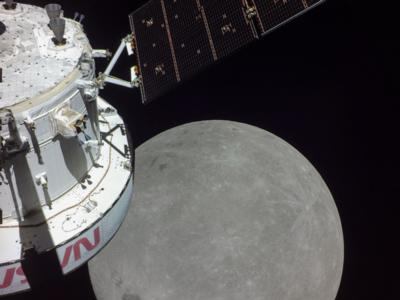
Orion’s distant retrograde orbit insertion burn as a part of the Artemis I mission took place at 1652 p.m. EST. Orion fired the orbital maneuvering system engine on its European service module to propel the spacecraft into an orbit over 40,000 miles above the surface of the Moon. The distant retrograde orbit provides a highly stable destination where little fuel is required to stay while engineers put Orion’s systems to the test in a deep space environment far from Earth. 

The orbital maneuvering system engine on the European Service Module is the main engine that provides the primary propulsion for Orion’s major in-space maneuvers. The engine provides 6,000 pounds of thrust and is equipped to steer the spacecraft. Orion’s European Service Module is provided by ESA (European Space Agency) with contributions from 10 European countries and the United States, including Germany, Italy, Switzerland, France, Belgium, Sweden, Denmark, Norway, Spain, and the Netherlands.  

Earlier in the day on flight day 10 of the 25.5-day mission, engineers continued planned testing with the star tracker in a variety of orientations in deep space as part of one of several flight test objectives.  

Orion is currently traveling over 237,000 miles from Earth and over 57,000 miles from the Moon, cruising at about 2,300 miles per hour.  

FMI: www.nasa.gov 

Advertisement

More News

ANN's Daily Aero-Term (12.04.25): Cooperative Surveillance

Cooperative Surveillance Any surveillance system, such as secondary surveillance radar (SSR), wide-area multilateration (WAM), or ADS-B, that is dependent upon the presence of cert>[...]

ANN's Daily Aero-Linx (12.04.25)

Aero Linx: OX5 Aviation Pioneers Incorporated in 1955 as a Pa 501 (c)(3) Not for Profit Corporation, the OX5 Aviation Pioneers is dedicated to bringing before the public the accomp>[...]

NTSB Prelim: Extra Flugzeugproduktions EA 300/SC

The Pilot Appeared To Regain Control After Six Rotations And Attempted To “Fly Out” Inverted But Had Insufficient Altitude On November 8, 2025, at 1038 eastern standard>[...]

Classic Aero-TV: The Bally Bomber - The All Time Ultimate Warbird Replica?

From 2018 (YouTube Edition): Aero-News Talks With The Airplane's Builder One of the many unique airplanes at AirVenture 2018 was a 1/3-scale B-17 bomber built by Jack Bally, who ta>[...]

ANN's Daily Aero-Linx (12.05.25)

Aero Linx: Society of U.S. Army Flight Surgeons (SoUSAFS) The Society of US Army Flight Surgeons (SoUSAFS) serves to advance the science and art of Aerospace Medicine and its allie>[...]

blog comments powered by Disqus



Advertisement

Advertisement

Podcasts

Advertisement

© 2007 - 2025 Web Development & Design by Pauli Systems, LC

