
Fire Scout Completes 1st Navy Unmanned Flight On Biofuel | Aero-News Network
Aero-News Network
RSS icon RSS feed
podcast icon MP3 podcast
Subscribe Aero-News e-mail Newsletter Subscribe

Airborne Unlimited -- Most Recent Daily Episodes

Episode Date

Airborne-Monday

Airborne-Tuesday

Airborne-Wednesday Airborne-Thursday

Airborne-Friday

Airborne On YouTube

Airborne-Unlimited-12.01.25

AirborneNextGen-
12.02.25

Airborne-Unlimited-12.03.25

Airborne-AffordableFlyers-11.20.25

AirborneUnlimited-11.21.25

LIVE MOSAIC Town Hall (Archived): www.airborne-live.net

Tue, Oct 04, 2011

Fire Scout Completes 1st Navy Unmanned Flight On Biofuel

VTOL UAS Becomes The Seventh Navy Aircraft To Demonstrate Biofuel Compatibility

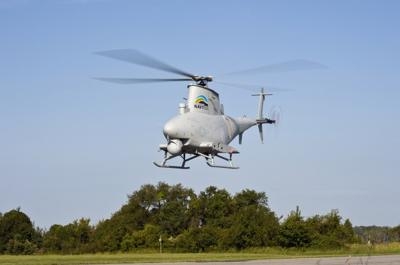
The Navy has successfully flown its first unmanned biofuel flight with an MQ-8B Fire Scout. The Unmanned Aircraft Systems Test Directorate at Webster Field in St. Inigoes, MD piloted the helicopter fueled with a combination of JP-5 aviation fuel and plant-based camelina. The biofuel blend reduces carbon dioxide output by 75 percent when compared to conventional aviation fuel.

Navy Photo

Rear Adm. Bill Shannon, program executive officer for Unmanned Aviation and Strike Weapons, said the flight "marks a significant milestone with Fire Scout being the Navy's first unmanned aircraft to use biofuel technology. I am very pleased we can add MQ-8B to the list of successful bioflights completed at Pax River this year, bringing us one step closer to achieving the Navy's energy goals."

The MQ-8B Fire Scout Vertical Take-Off and Landing Tactical Unmanned Aerial Vehicle provides critical situational awareness, intelligence, surveillance, reconnaissance (ISR), and targeting data to the forward deployed warfighter. Fire Scout is designed to operate from all air capable ships and is currently providing ISR support during its first-land based deployment in U.S. Central Command area of responsibility.

Fire Scout is the seventh aircraft to demonstrate the versatility of biofuel through its use in all facets of naval aviation. The completion of aircraft biofuel testing at Pax River is another example of the Navy's determination in achieving its goal of launching the "Great Green Fleet."

This initiative is one of many throughout the Navy and Marine Corps which will enable the Department of the Navy to achieve the Secretary Ray Mabus' energy goals to improve our energy security and efficiency afloat and ashore, increase our energy independence, and help lead the nation toward a clean energy economy.

FMI: www.navy.mil

Advertisement

More News

ANN's Daily Aero-Term (12.01.25): Convective SIGMET

Convective SIGMET A weather advisory concerning convective weather significant to the safety of all aircraft. Convective SIGMETs are issued for tornadoes, lines of thunderstorms, e>[...]

ANN's Daily Aero-Linx (12.01.25)

Aero Linx: United Flying Octogenarians WELCOME to a most extraordinary group of aviators, the United Flying Octogenarians (UFO). Founded in 1982 with just a handful of pilots, we h>[...]

NTSB Final Report: Remos Aircraft GmbH Remos GX

Pilot’s Decision To Attempt Takeoff With Frost Covering The Airplane’s Wings Analysis: The pilot of the light sport airplane was preparing to depart for a cross-country>[...]

Aero-News: Quote of the Day (12.02.25)

“We’ve paid for the cable line’s repair for the customer and have apologized for the inconvenience this caused them...” Source: Some followup info from an A>[...]

ANN's Daily Aero-Term (12.02.25): Coupled Approach

Coupled Approach An instrument approach performed by the aircraft autopilot, and/or visually depicted on the flight director, which is receiving position information and/or steerin>[...]

blog comments powered by Disqus



Advertisement

Advertisement

Podcasts

Advertisement

© 2007 - 2025 Web Development & Design by Pauli Systems, LC

