Helped Scientists Define Estimates Of Asteroid's Size And Rotation
Scientists working with NASA's 230-foot-wide Deep Space Network antenna at Goldstone, CA, have released a second, longer, more refined movie clip of asteroid 1998 QE2 and its moon. The 55 individual images used in the movie were generated from data collected at Goldstone on June 1, 2013. Each of the individual images obtained on June 1, 2013, required about five minutes of data collection by the Goldstone radar. At the time of the observations that day, asteroid 1998 QE2 was about 3.75 million miles from Earth. The resolution is about 125 feet per pixel.
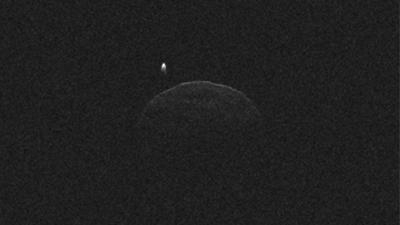
With additional radar images and time for analysis, NASA scientists have been able to refine their estimates of the asteroid's size and rotation. The data indicate the main, or primary body, is approximately 1.9 miles (3 kilometers) in diameter and has a rotation period of about five hours.
The asteroid's satellite, or moon, is approximately 2,000 feet wide, has an elongated appearance, and completes a revolution around its host body about once every 32 hours. At any point during its orbit, the maximum distance between the primary body and moon is about 4 miles. Similar to our moon, which always points the same "face" at Earth, the asteroid's satellite appears to always show the same portion of its surface to the primary asteroid. This is called "synchronous rotation."
1998 QE2 is one of the slowest (with respect to its rotation) and largest binaries that have been observed by planetary radar. In the near-Earth population, about 16 percent of asteroids that are about 655 feet or larger are binary or triple systems.
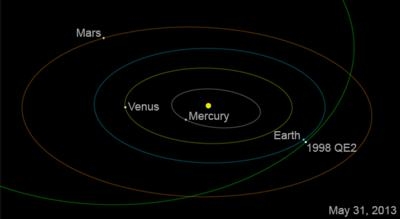
The trajectory of asteroid 1998 QE2 is well understood. The closest approach of the asteroid occurred on May 31 at 4:59 p.m. EDT, when the asteroid got no closer than about 3.6 million miles, or about 15 times the distance between Earth and the moon. This was the closest approach the asteroid will make to Earth for at least the next two centuries.
Asteroid 1998 QE2 was discovered on Aug. 19, 1998, by the Massachusetts Institute of Technology Lincoln Near Earth Asteroid Research (LINEAR) program near Socorro, NM.
Radar is a powerful technique for studying an asteroid's size, shape, rotation state, surface features and surface roughness, and for improving the calculation of asteroid orbits. Radar measurements of asteroid distances and velocities often enable computation of asteroid orbits much further into the future than if radar observations weren't available.
NASA places a high priority on tracking asteroids and protecting our home planet from them. In fact, the US has the most robust and productive survey and detection program for discovering near-Earth objects (NEOs). To date, U.S. assets have discovered over 98 percent of the known NEOs. In 2012, the NEO budget was increased from $6 million to $20 million. Literally dozens of people are involved with some aspect of NEO research across NASA and its centers. Moreover, there are many more people involved in researching and understanding the nature of asteroids and comets, including those objects that come close to Earth, plus those who are trying to find and track them in the first place.
In 2016, NASA will launch a robotic probe to one of the most potentially hazardous of the known NEOs. The OSIRIS-REx mission to asteroid (101955) Bennu will be a pathfinder for future spacecraft designed to perform reconnaissance on any newly-discovered threatening objects. Aside from monitoring potential threats, the study of asteroids and comets enables a valuable opportunity to learn more about the origins of our solar system, the source of water on Earth, and even the origin of organic molecules that led to the development of life.
(Images provided by NASA)



 Aero-News: Quote of the Day (12.11.25)


 See All