
First Tranche 3 Typhoon Completes Engine Testing | Aero-News Network
Aero-News Network
RSS icon RSS feed
podcast icon MP3 podcast
Subscribe Aero-News e-mail Newsletter Subscribe

Airborne Unlimited -- Most Recent Daily Episodes

Episode Date

Airborne-Monday

Airborne-Tuesday

Airborne-Wednesday Airborne-Thursday

Airborne-Friday

Airborne On YouTube

Airborne-Unlimited-12.08.25

AirborneNextGen-
12.02.25

Airborne-Unlimited-12.03.25

Airborne-FltTraining-12.04.25

AirborneUnlimited-12.05.25

AFE 2025 LIVE MOSAIC Town Hall (Archived): www.airborne-live.net

Sun, Nov 10, 2013

First Tranche 3 Typhoon Completes Engine Testing

Ground Runs Carried Out In Three Distinct Phases

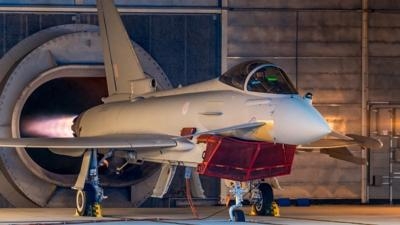
The first Tranche 3 Typhoon, designated BS116, has successfully completed engine ground runs at the BAE de-tuner facility at Warton, U.K.

According to the company, the Tranche 3 jet offers a number of provisions that future proof the aircraft and will allow it to take on additional capability in the future including e-scan radar, conformal fuel tanks and a high speed data network.

The engine ground runs were carried out in 3 distinct phases. Green screens involve a final check of the airframe for foreign object debris (FOD) using a wire mesh screen attached directly to the front of the engine.  The engines are then started up and any FOD that has not been found in the production process, through manual and X-ray searches, is sucked towards the engine and caught on the green screen.

Installation runs carried out by the on-site Rolls Royce representative. Each engine is operated individually before both are fired up together and run through the full performance range all the way up to maximum re-heat. These are the final checks and sign-off to ensure the engines meet all of the performance and design criteria.

Finally, once the engines have been certified as fully serviceable, we test the way the engine interfaces with all of the aircraft systems. We check the environmental control system, that’s cooling for the avionic equipment and also for the pilot, the fuel system to make sure the engine receives fuel in the correct way, life support to make sure the pilot’s oxygen generation system works, the electrical power generation to ensure it’s working correctly and also the hydraulic system that supplies the flying control system.
 
Engine ground runs are the last stage of testing before the aircraft makes its first flight which is currently on target to take place before the year end.

(Image provided by BAE Systems)

FMI: www.bae.com

Advertisement

More News

Aero-News: Quote of the Day (12.07.25)

“This vote sends an undeniable message to Air Transat management: We are unified, resolute, and have earned a contract that reflects today’s industry standards, not the>[...]

ANN's Daily Aero-Linx (12.07.25)

Aero Linx: Beech Aero Club The Beech Aero Club (BAC) is the international type club for owners and pilots of the Beech Musketeer aircraft and its derivatives, the Sport, Super, Sun>[...]

NTSB Final Report: Lafferty Jack Sea Rey

While Landing In The River, The Extended Landing Gear Contacted The Water And The Airplane Nosed Over, Resulting In Substantial Damage Analysis: The pilot of the amphibious airplan>[...]

Classic Aero-TV: The B29 SuperFortress ‘Doc’ - History in Flight

From 2022 (YouTube Edition): Carrying the Legacy of The B-29 For Generations to Come We had a chance to chat with the Executive Director of B-29 Doc, Josh Wells, during their stop >[...]

Airborne 12.08.25: Samaritan’s Purse Hijack, FAA Med Relief, China Rocket Fail

Also: Cosmonaut Kicked Out, Airbus Scales Back, AF Silver Star, Russian A-60 Clobbered A Samaritan’s Purse humanitarian flight was hijacked on Tuesday, December 2, while atte>[...]

blog comments powered by Disqus



Advertisement

Advertisement

Podcasts

Advertisement

© 2007 - 2025 Web Development & Design by Pauli Systems, LC

