

FAA, EASA Give Steep Approach Approval To Gulfstream 150 | Aero-News Network
Aero-News Network
RSS icon RSS feed
podcast icon MP3 podcast
Subscribe Aero-News e-mail Newsletter Subscribe

Airborne Unlimited -- Most Recent Daily Episodes

Episode Date

Airborne-Monday

Airborne-Tuesday

Airborne-Wednesday Airborne-Thursday

Airborne-Friday

Airborne On YouTube

Airborne-Unlimited-12.01.25

AirborneNextGen-
12.02.25

Airborne-Unlimited-12.03.25

Airborne-AffordableFlyers-11.20.25

AirborneUnlimited-11.21.25

LIVE MOSAIC Town Hall (Archived): www.airborne-live.net

Wed, Feb 03, 2010

FAA, EASA Give Steep Approach Approval To Gulfstream 150

Capability Key To Access At Some European And Canadian Airports

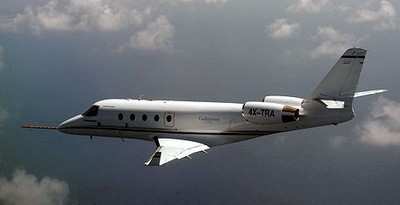
Gulfstream announced Tuesday that the Gulfstream G150 aircraft has achieved steep approach certification from the FAA and the European Aviation Safety Agency (EASA). This approval allows the G150 to operate at airports with an approach angle of up to 6 degrees. Most airports have an approach angle of 3.5 degrees or less.

File Photo

Several airports worldwide require steep approach certification to land at their facility due to terrain, obstacles or local noise ordinances. They include: Lugano in Switzerland; Sion in Switzerland; Stephenville International in Newfoundland, Canada; Marseille Provence in Marignane, France; and Chambery in Le Viviers du Lac, France.

The G150 is the first Gulfstream aircraft to receive steep approach certification from the FAA and EASA.

In October 2006, the mid-size, high-speed G150 business jet was certified by the FAA for Stage 4, the industry’s most stringent noise standards. It was the first Gulfstream business jet to be certified to this standard. Additionally, the G150 has group Reduced Vertical Separation Minimum (RVSM) approval.

“These FAA and EASA certifications allow our Gulfstream G150 operators around the world greater flexibility, particularly the operators in Europe,” said Pres Henne, senior vice president, Programs, Engineering and Test.

The G150 successfully completed its first flight on May 3, 2005, and was simultaneously certified by both the FAA and the Civil Aviation Administration of Israel on Nov. 7, 2005. Powered by two fuel-efficient Honeywell TFE731 engines, the wide-cabin aircraft has a range of 2,959 nautical miles at 0.75 Mach.

FMI: www.faa.gov, www.easa.europa.eu

Advertisement

More News

ANN's Daily Aero-Term (12.01.25): Convective SIGMET

Convective SIGMET A weather advisory concerning convective weather significant to the safety of all aircraft. Convective SIGMETs are issued for tornadoes, lines of thunderstorms, e>[...]

ANN's Daily Aero-Linx (12.01.25)

Aero Linx: United Flying Octogenarians WELCOME to a most extraordinary group of aviators, the United Flying Octogenarians (UFO). Founded in 1982 with just a handful of pilots, we h>[...]

NTSB Final Report: Remos Aircraft GmbH Remos GX

Pilot’s Decision To Attempt Takeoff With Frost Covering The Airplane’s Wings Analysis: The pilot of the light sport airplane was preparing to depart for a cross-country>[...]

Aero-News: Quote of the Day (12.02.25)

“We’ve paid for the cable line’s repair for the customer and have apologized for the inconvenience this caused them...” Source: Some followup info from an A>[...]

ANN's Daily Aero-Term (12.02.25): Coupled Approach

Coupled Approach An instrument approach performed by the aircraft autopilot, and/or visually depicted on the flight director, which is receiving position information and/or steerin>[...]

blog comments powered by Disqus



Advertisement

Advertisement

Podcasts

Advertisement

© 2007 - 2025 Web Development & Design by Pauli Systems, LC

