Airservices Australia, Aireon Sign MOA To Improve Airspace Safety
Airservices Australia, Australia's Air Navigation Service Provider (ANSP) and Aireon LLC have signed a Memorandum of Agreement (MOA) under which Airservices will assess the concept of Aireon's space-based Automatic Dependent Surveillance-Broadcast (ADS-B) solution.

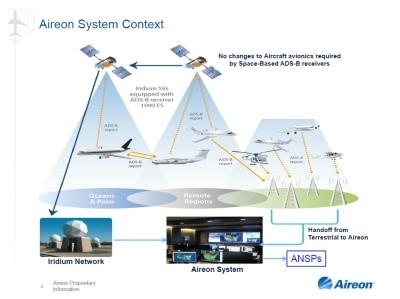
Aireon's space-based ADS-B system would be the first 100 percent global air traffic surveillance solution. Aireon will enable real-time air traffic surveillance everywhere in the world, including full coverage over oceans, mountains, remote areas and polar regions.
The Aireon ADS-B solution will facilitate smooth transition with neighboring Flight Information Regions (FIR) while also lowering ground infrastructure costs, reducing costs to airlines and improving airspace safety. The solution, utilizing ADS-B receivers launching as part of the Iridium NEXT satellite constellation, is expected to be operative by 2018.
Leading ANSP Airservices Australia manages air traffic control, aviation rescue and air navigation services for over 20 million square nautical miles of airspace. This includes commanding air traffic operations for over 90 million passengers on more than four million flights every year.
Airservices has been operationally separating aircraft with ADS-B for a decade and became the first ANSP to commission a continent-wide ADS-B system. It now has more than 60 percent of Australia-based aircraft IFR flights ADS-B equipped. That number is slated to increase due to Australia's safety regulator, the Civil Aviation Safety Authority (CASA), mandating that all IFR aircraft flying in Australia's airspace be ADS-B equipped by February 2017.
"We are interested in examining how space-based ADS-B could potentially be used in the future and will work with Aireon to determine the potential safety benefits of the technology and efficiency benefits it may offer for our customers, especially for oceanic services and in cross-boundary coordination with our neighbors," said Greg Hood, Executive General Manager Air Traffic Control, Airservices Australia.
"There is potential for space-based ADS-B to offer value not only to Airservices, but for all of our customer airlines, airports and search and rescue teams and we are keen to explore that in further detail."
"Airservices operates, maintains and controls over 11 percent of the world's airspace, much of which is oceanic," said Cyriel Kronenburg, vice president, Aireon. "Airservices has always been a leader in investing in best-in-class systems and an early adopter of technology to not only improve efficiency and reduce separation, but also increase safety. Airservices and Aireon will collaborate to examine the value of space-based ADS-B. Also, by gaining a better understanding of how Aireon's system will improve operations, they will also be able to consider the savings that the service may provide."
Airservices joins a growing list of ANSPs, airlines and regulators who are exploring the use of Aireon's space-based ADS-B surveillance system. Aireon is currently working with UK NATS, the Agency for Aerial Navigation Safety in Africa and Madagascar, Airports Authority of India, Civil Aviation Authority of Singapore, Blue Med Functional Airspace Block, the FAA, Airways New Zealand and Isavia.
(Source: Aireon news release)



 ANN's Daily Aero-Term (12.08.25): Decision Altitude (DA)


 See All