Tue, Jul 10, 2018
Inadequate Flight Planning Led To To The Incident, Board Says
In its recently-release investigation report, the Transportation Safety Board of Canada (TSB) found that inadequate flight planning led to an aircraft colliding with runway lights after landing at the Montreal/St-Hubert Airport, Quebec.
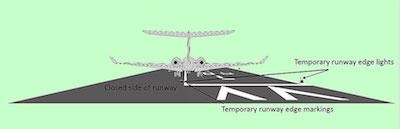
On 15 May 2017, a U.S.-registered Bombardier Global Express aircraft was flying from Teterboro, New Jersey, to Montreal/St-Hubert Airport, Quebec, with three crew members and one passenger on board. The aircraft was cleared to land on Runway 06L at Montreal/St-Hubert Airport, which had been reduced in size to 75 feet wide and 5000 feet long due to construction work. At about 1055 local time, the aircraft touched down partially outside of the confines of the reduced-width runway, striking seven temporary runway edge lights. The pilot flying brought the aircraft back to the reduced-width runway centreline before coming to a stop 300 feet from the shortened runway end. There were no injuries but the aircraft sustained substantial damage.
The investigation found that the crew's flight planning did not adequately prepare them to ensure a safe landing. The flight crew believed that the entire width of the runway was available, despite notices to airmen (NOTAMs), communication with the air traffic controller and other information indicating the reduced runway size. Before landing, the flight crew misinterpreted the runway markings, and the pilot flying perceived the runway side stripe marking along the left edge of the runway as being the runway centreline. As a result, the aircraft touched down partly outside the limits of the available runway.
The approach briefing conducted by the flight crew did not include a review of the NOTAMs in effect at the airport, as required by the aircraft operator. This review could have made the crew aware of the reduced runway width prior to landing. If flight crews conduct incomplete approach briefings, there is a risk that information that is crucial for flight safety will be missed.
Following the occurrence, the operator of Montreal/St-Hubert Airport added a popup window to its website. It contained a message describing the construction work and specified that flight crews must read the notices to airmen in effect at the airport. Flight crews could also download a diagram of the construction work.
(Image provided with Transportation Safety Board of Canada report)
More News
“We respectfully call on the City of Mesa to: 1. Withdraw the landing fee proposal immediately 2. Engage with the aviation community before making decisions that impact safet>[...]
High Speed Taxiway A long radius taxiway designed and provided with lighting or marking to define the path of aircraft, traveling at high speed (up to 60 knots), from the runway ce>[...]
Aero Linx: International Federation of Airworthiness (IFA) IFA uniquely combines together all those with responsibility for policies, principles and practices concerned with the co>[...]
Controller’s Expectation That VW02 Would Have Departed Sooner Led To An Inadequate Scan And Loss Of Situational Awareness Analysis: A Robinson R-44 helicopter N744AF, VW02 (V>[...]
A Few Questions AND Answers To Help You Get MORE Out of ANN! 1) I forgot my password. How do I find it? 1) Easy... click here and give us your e-mail address--we'll send it to you >[...]



 Aero-News: Quote of the Day (12.09.25)


 See All