

Schiaparelli Lander Preparing For Mars Mission | Aero-News Network
Aero-News Network
RSS icon RSS feed
podcast icon MP3 podcast
Subscribe Aero-News e-mail Newsletter Subscribe

Airborne Unlimited -- Most Recent Daily Episodes

Episode Date

Airborne-Monday

Airborne-Tuesday

Airborne-Wednesday Airborne-Thursday

Airborne-Friday

Airborne On YouTube

Airborne-Unlimited-12.08.25

AirborneNextGen-
12.09.25

Airborne-Unlimited-12.10.25

Airborne-AffordableFlyers-12.11.25

AirborneUnlimited-12.12.25

AFE 2025 LIVE MOSAIC Town Hall (Archived): www.airborne-live.net

Tue, Oct 11, 2016

Schiaparelli Lander Preparing For Mars Mission

Commands For Descent And Landing Uploaded To The Spacecraft Traveling To Mars

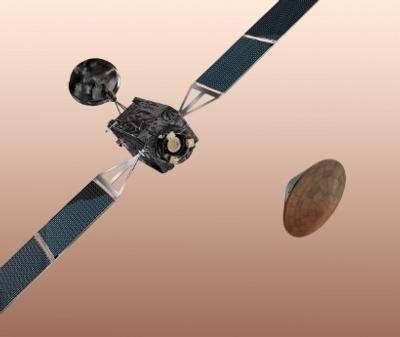
This week, the commands that will govern the Schiaparelli lander’s descent and touchdown on Mars were uploaded to ESA’s ExoMars spacecraft, enroute to the Red Planet.

The Trace Gas Orbiter has been carrying the Schiaparelli entry, descent and landing demonstrator since launch on 14 March. Upon arrival on 19 October, Schiaparelli will test the technology needed for Europe’s 2020 rover to land, while its parent craft brakes into an elliptical orbit around Mars.

This week’s uploading was conducted by the Orbiter team working at ESA’s mission control in Darmstadt, Germany, and marked a significant milestone in readiness for arrival.

Schiaparelli’s operations are governed by time-tagged stored commands, ensuring that the lander can conduct its mission even when out of contact with any of the Mars orbiters that will serve as data relays.

Automated operation also ensures that the lander will revive from its power-saving sleep periods on the surface in time for communication links.

The commands were uploaded in two batches. The first, containing the hibernation wake-up timers and the surface science instrument timeline, was uploaded on 3 October. The second, containing the rest of the mission command sequence, was uploaded to the module on 7 October.

“Uploading the command sequences is a milestone that was achieved following a great deal of intense cooperation between the mission control team and industry specialists,” says Orbiter flight director Michel Denis.

One of the most crucial moments will be the moment of landing, set for 14:48:11 GMT (16:48:11 CEST) on 19 October. Now that this time has been fixed, the rest of the commands will play out in sequence counting down or up.

The science activities are designed to make the most of the limited energy available from the batteries, so they will be performed in set windows rather than continuously – typically, for six hours each day.

The timeline will also switch on the module’s transmitter during a series of fixed slots to send recorded data up to ESA and NASA orbiters passing overhead, which will then transmit the data to Earth.

During landing, these commands include ejecting the front and back aeroshells, operating the descent sensors, deploying the braking parachute and activating three groups of hydrazine thrusters to control its touchdown speed.

A radar will measure Schiaparelli’s height above the surface starting at about 7 km. At around 2 m, Schiaparelli will briefly hover before cutting its thrusters, leaving it to fall freely.

Once safely on the surface, the timeline will operate the science instruments for a planned two days – and possibly longer.

(Images provided with ESA news release and from file)

FMI: www.esa.int

Advertisement

More News

Aero-News: Quote of the Day (12.09.25)

“We respectfully call on the City of Mesa to: 1. Withdraw the landing fee proposal immediately 2. Engage with the aviation community before making decisions that impact safet>[...]

ANN's Daily Aero-Term (12.09.25): High Speed Taxiway

High Speed Taxiway A long radius taxiway designed and provided with lighting or marking to define the path of aircraft, traveling at high speed (up to 60 knots), from the runway ce>[...]

ANN's Daily Aero-Linx (12.09.25)

Aero Linx: International Federation of Airworthiness (IFA) IFA uniquely combines together all those with responsibility for policies, principles and practices concerned with the co>[...]

NTSB Final Report: Diamond Aircraft Ind Inc DA20C1 (A1); Robinson Helicopter R44

Controller’s Expectation That VW02 Would Have Departed Sooner Led To An Inadequate Scan And Loss Of Situational Awareness Analysis: A Robinson R-44 helicopter N744AF, VW02 (V>[...]

ANN FAQ: Q&A 101

A Few Questions AND Answers To Help You Get MORE Out of ANN! 1) I forgot my password. How do I find it? 1) Easy... click here and give us your e-mail address--we'll send it to you >[...]

blog comments powered by Disqus



Advertisement

Advertisement

Podcasts

Advertisement

© 2007 - 2025 Web Development & Design by Pauli Systems, LC

